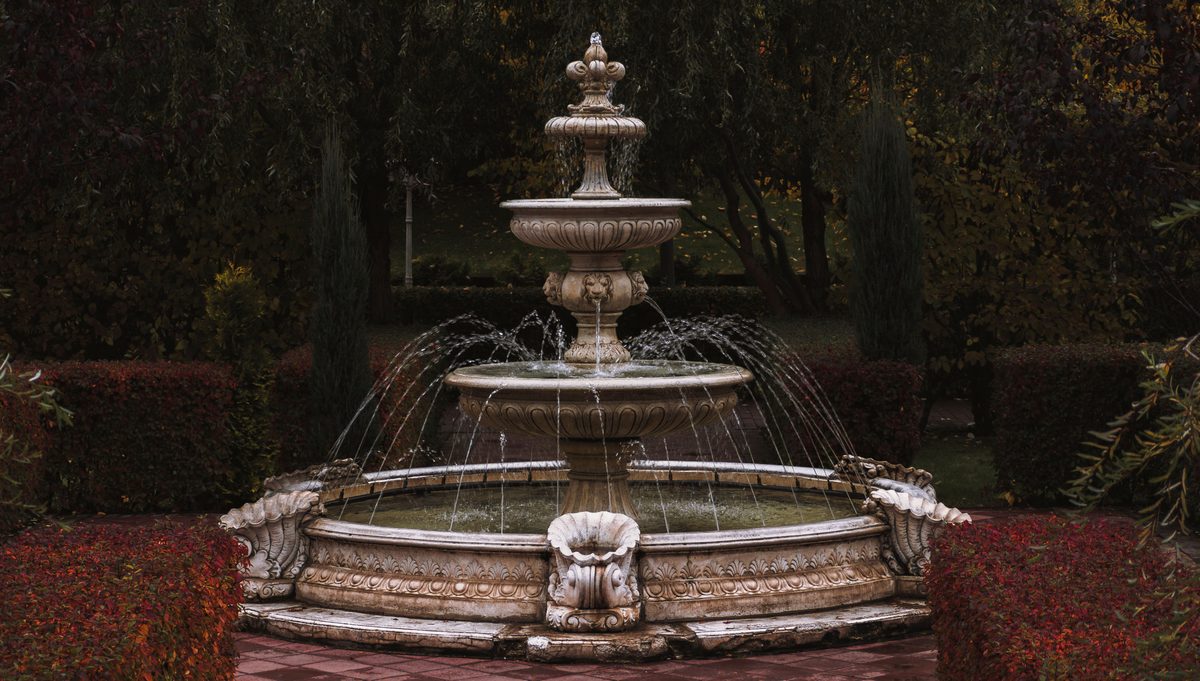
 A self-contained fountain operates through a closed-loop recirculation system that continuously moves and reuses the same water. Understanding water feature design & fundamentals helps homeowners select appropriate systems matching their space, budget, and aesthetic goals for outdoor fountain installations. An electric pump draws water from a reservoir basin and pushes it to the highest point.
Gravity returns the water through cascading tiers or spouts back into the basin. This fountain operation creates continuous water movement without requiring connection to municipal water supplies or drainage systems.
Key Takeaways
- Self-contained fountains are compact, plug-and-play water features with built-in recirculation systems requiring minimal installation
- These fountain systems include essential components: basin reservoir (20–100 gallons), recirculating pump (500–2,000 GPH), and GFCI-protected electrical connection
- Maintenance requirements average only 4–8 hours annually compared to 40–80 hours for traditional koi ponds
- Initial costs range from $20–$200 for budget models to $800–$5,000 for premium installations with integrated features
- Proper pump sizing, electrical safety, and water quality management ensure optimal performance and longevity
What Defines a Self-Contained Fountain?
Water feature design & fundamentals begin with understanding that self-contained fountains are complete, integrated units requiring no external plumbing or permanent installation. These portable fountain systems include all necessary components within a single structure: basin, pump, water delivery tubing, and decorative elements. The self-contained design means homeowners can place them on patios, courtyards, or gardens with only access to a standard electrical outlet.
Unlike traditional ponds or built-in fountains requiring excavation and permanent infrastructure, self-contained units offer flexibility and simplicity. Most models operate as plug-and-play systems ready for immediate use after water filling and electrical connection.
What Are the Key Components of a Self-Contained Fountain?
The fountain system relies on several integrated elements working together to create continuous water circulation. Basin capacity typically ranges from 20 to 100 gallons, depending on fountain size. Recirculating pumps deliver 500 to 2,000 GPH for standard courtyard features, with GPH measuring the pump’s flow rate capacity.
Advanced fountain components may include auto-fill valves that automatically maintain optimal water levels through a municipal connection. UV clarifiers use ultraviolet light to control algae growth and maintain water clarity without chemical treatments.
How Does the Closed-Loop Recirculation System Operate?
The closed-loop recirculation system continuously moves and reuses the same water through mechanical pumping and gravity return. Water flows from the basin through the pump intake, up the internal tubing, out the spout or cascade feature, then back to the basin. This fountain operation eliminates the need for a continuous water supply or drainage infrastructure connections.
Self-contained fountains function as compact, plug-and-play units, including tabletop, pedestal, and basin fountains suitable for various spaces. The recirculation mechanism conserves water compared to flow-through systems while maintaining continuous movement for aesthetic and auditory benefits. Evaporation represents the only water loss requiring periodic refilling.
What Materials and Designs Are Commonly Used?
Construction material shapes a fountain’s cost, weight, and upkeep. The table below compares the most common options.
| Material | Characteristics | Cost and Weight |
|---|---|---|
| Fiberglass | Lightweight and durable, suits most residential applications | Lower cost, lightweight |
| Resin | Weather-resistant, mimics stone or ceramic finishes | Reduced cost and weight |
| Natural Stone (marble, granite, limestone) | Premium, natural aesthetics | Substantial weight, higher investment |
| Concrete | Durable and customizable for artistic designs | Moderate to higher cost, heavy |
| Stainless Steel or Copper | Contemporary look for modern architecture | Moderate to higher cost, moderate weight |
Concrete construction creates durable, customizable designs allowing for artistic expression and long-term outdoor performance. Stainless steel or copper materials suit contemporary installations with modern architectural styling. Material selection influences initial cost, maintenance needs, aesthetic character, portability, and expected lifespan, ranging from 10 to 50-plus years.
What Are the Advantages and Limitations of Self-Contained Fountains?
Water feature design & fundamentals demonstrate that self-contained systems offer the lowest maintenance burden among decorative water features. Annual maintenance averages only 4 to 8 hours compared to 40 to 80 hours for koi ponds. Research shows 53 percent of homeowners emphasize ease of care as a primary decision factor when selecting landscape features.
Consumer priorities reveal that 49 percent of homeowners prioritize aesthetics and curb appeal. Environmental benefits attract 19 percent of homeowners seeking water-efficient, recirculating systems. Wellness benefits, including stress reduction, motivate 14 percent of homeowners to add water features to outdoor spaces.
What Benefits Do They Offer for Homeowners?
Low maintenance requirements make self-contained fountains accessible to busy homeowners. Installation simplicity eliminates excavation, grading, and permanent plumbing work required for traditional water features. Portable designs allow repositioning to optimize aesthetic impact, seasonal use, or relocation when moving residences.
Compact footprints suit urban lots, courtyard spaces, and patios where full ponds prove impractical. Lower initial costs, ranging from $20 to $5,000, provide entry points across budget levels compared to $15,000-plus for koi ponds. Immediate functionality upon installation delivers satisfaction without lengthy construction timelines.
What Maintenance Challenges Should Owners Expect?
Algae and mineral buildup occur in standing water exposed to sunlight, requiring regular cleaning and occasional chemical treatment. Pump failure immediately stops water flow, necessitating replacement or repair. Frequent refilling becomes necessary in hot climates for small fountains experiencing significant evaporation losses exceeding one inch weekly.
Noise levels vary considerably across designs, with some producing unwanted splashing sounds. Limited wildlife habitat capacity means self-contained fountains provide minimal ecological benefits compared to ecosystem ponds. Regular maintenance practices, including debris removal, pump inspection, and water quality monitoring, ensure continued performance.
How Do They Compare to Other Water Feature Types?
Maintenance hours, cost tiers, and lifespan vary widely across water feature types, as the comparison below shows.
| Metric | Self-Contained Fountain | Koi Pond | Pondless Waterfall |
|---|---|---|---|
| Annual Maintenance | 4 to 8 hours | 40 to 80 hours | Moderate (filtration and debris upkeep) |
| Budget Tier Cost | $20 to $200 | $500 to $2,000 | $5,000 to $10,000 |
| Mid-Range Cost | $200 to $800 | $3,000 to $15,000 | $10,000 to $25,000 |
| Premium Cost | $800 to $5,000 | $15,000-plus | $25,000 to $59,000-plus |
| Typical Lifespan | 10 to 50-plus years (material dependent) | 20 to 30-plus years | 30 to 50-plus years (formal builds) |
Pondless waterfalls fall between the two, running $5,000 to $10,000 for budget builds and up to $59,000-plus for premium installations.
How Does the Pump and Waterflow Mechanism Function?
The recirculating pump forms the mechanical heart of any fountain system, delivering continuous water circulation through electrical motor power. Submersible pumps sit within the basin reservoir, drawing water through intake screens, while external pumps mount outside the water reservoir. Pump capacity measured in GPH determines flow volume, with appropriate sizing critical for achieving desired aesthetic effects.
Head height, representing the vertical distance the pump must push water against gravity, influences the required pump strength. Proper matching of pump specifications to fountain dimensions ensures optimal performance, energy efficiency, and satisfying water effects.
How Is Pump Size Determined for Optimal Performance?
Select a pump with adequate GPH and head height capacity matching the fountain’s physical dimensions and desired water effects. Head height measures the vertical distance the pump must push water from the basin surface to the highest discharge point. Recirculating pump capacity for pondless waterfalls typically ranges from 1,000 to 5,000 GPH, depending on height and desired flow volume.
Manufacturers provide pump performance curves showing GPH output at various head heights, enabling accurate selection. Undersizing results in weak flow while oversizing wastes energy and creates maintenance problems.
What Role Does the Reservoir Capacity Play?
Ensure basin capacity provides sufficient volume to minimize refilling frequency based on evaporation rates and climate conditions. Small backyard installation basins typically hold 20 to 50 gallons, balancing compact size with adequate reserve volume. Larger reservoirs reduce maintenance frequency but increase space requirements and material costs.
Basin volume must accommodate water displaced when the pump stops operating. Insufficient capacity causes overflow when the pump shuts off, potentially damaging surrounding surfaces. Proper basin sizing accounts for total system volume, evaporation losses, and operational water displacement requirements.
How Is Electrical Safety Ensured in Operation?
GFCI-protected electrical outlets are required by electrical code for all outdoor water features, preventing electrical shock hazards. Standard electrical requirements specify 110-volt GFCI-protected outdoor outlets located within 50 feet of fountain placement.
Underground electrical conduit provides permanent, code-compliant power delivery for fixed fountain locations requiring professional electrician installation. Extension cords should use outdoor-rated GFCI protection for temporary or seasonal fountain placement. Regular GFCI testing confirms continued protection functionality, with monthly test button activation recommended.
What Are Best Practices for Installation and Maintenance?
Proper fountain installation begins with strategic site selection considering drainage, electrical access, visibility, and landscape integration. Verify adequate drainage, ensuring water flows away from house foundations. Confirm proximity to electrical outlets within 50 feet, reducing extension cord requirements. Assess soil conditions, identifying clay versus rocky substrates affecting excavation difficulty. Locate utilities before any excavation, including water lines, gas lines, and electrical conduit.
How Should a Self-Contained Fountain Be Properly Installed?
Site preparation requires level placement to prevent uneven water distribution and pump strain. Foundation surfaces should provide stable support, preventing settling or structural stress. Gravel or paver bases improve drainage beneath fountains, preventing standing water accumulation.
Electrical connection must utilize GFCI-protected circuits with weatherproof outlet covers. Pump placement within the basin should allow easy access for maintenance while ensuring intake screens remain submerged during normal operation. Initial water fill should occur slowly, checking for leaks before activating the pump.
What Are Maintenance Recommendations for Longevity?
Periodically clean pumps, removing mineral deposits, algae buildup, and debris accumulation that reduce flow efficiency and shorten equipment lifespan. Inspect for leaks, checking basin seams, plumbing connections, and decorative element joints. Remove debris, including leaves, pollen, and wind-blown material.
Adjust water levels as needed, maintaining proper reservoir depth for pump operation. Maintenance costs typically represent 5 to 10 percent of the initial installation cost annually. Preventive maintenance schedules reduce emergency repair frequency and extend overall system lifespan.
How Can Water Quality and Algae Growth Be Managed?
Implement filtration and UV clarification systems controlling biological growth and maintaining water clarity. Algae growth occurs on surfaces exposed to sunlight, requiring periodic scrubbing and chemical control. Mechanical filtration removes physical debris, including leaves and algae fragments, before they decompose.
Biological filtration utilizes beneficial bacteria converting toxic ammonia and nitrites into less harmful nitrates. Water quality management combines filtration, circulation, chemical treatment, and algae control, maintaining clear, attractive water. Regular testing of pH, mineral content, and biological activity guides treatment decisions.
How Do Environmental and Site Factors Affect Fountain Operation?
Climate conditions significantly influence water loss rates, maintenance frequency, and seasonal operation feasibility for self-contained fountains. Orange County experiences a Mediterranean climate with warm, dry summers and minimal winter freezing, creating year-round fountain operation potential. Temperature extremes, humidity levels, wind exposure, and precipitation patterns all affect water evaporation rates.
Site-specific factors, including sun exposure, wind patterns, surrounding vegetation, and hardscape materials, influence microclimate conditions. These environmental variables determine refilling frequency, algae growth rates, and equipment wear.
What Impact Do Climate and Location Have on Water Loss?
Water evaporation reaches 0.5 to 1 inch per week during summer months in warm, dry climates, requiring regular monitoring and refilling. Orange County’s Mediterranean climate features warm, dry summers, creating favorable conditions for fountain operation. Wind exposure dramatically increases evaporation rates, while sun exposure heats water, accelerating moisture release. Shaded fountain locations reduce evaporation by 30 to 50 percent compared to full-sun placements.
How Can Placement Minimize Evaporation and Evade Water Conservation Issues?
Position fountains to minimize direct sunlight and wind exposure, reducing evaporation rates. Partial shade from structures, trees, or pergolas decreases surface water temperature, slowing evaporation. Windbreaks, including walls, hedges, or architectural features, reduce air movement across water surfaces, significantly decreasing moisture loss.
Install automatic water supply systems for larger fountains, maintaining consistent water levels without manual monitoring. Auto-fill valves connect to municipal water supplies, adding water when reservoir levels drop below preset thresholds.
What Water Conservation Measures Are Recommended?
Use recirculating systems to comply with water conservation regulations prohibiting flow-through water features in drought-prone regions like California. Install auto-fill systems for features larger than 100 gallons, automating water replacement and preventing pump damage from low water conditions.
Basin covers reduce evaporation by 70 to 90 percent when fountains remain inactive, allowing overnight or seasonal shutdown. Energy-efficient pump selection and proper sizing reduce electricity consumption. Recycled or greywater systems provide alternative water sources for fountain operation where regulations permit.
How Do Self-Contained Fountains Fit Within Consumer Preferences and Trends?
Self-contained fountains represent 45 percent of the outdoor water feature market, reflecting strong consumer preference for accessible, low-maintenance options. Ponds account for 30 to 35 percent of market share, while waterfalls and other features comprise the remaining 20 to 25 percent. The global outdoor water feature market reached $3.5 billion in 2024, with projections indicating growth to $4.9 billion by 2029.
Consumer research shows 18 percent of U.S. homeowners undertaking outdoor renovations added or upgraded water features in 2024. Yelp search interest for water features increased 36 percent year-over-year from April 2023 to April 2024.
Who Are the Ideal Customers for Self-Contained Fountains?
Millennials show the highest outdoor living engagement, with 89 percent extending living space outdoors. Gen X follows with 75 percent, while Baby Boomers reach 60 percent adoption rates. Younger homeowners demonstrate higher receptivity to integrated water features with automation and technology-enhanced experiences.
Urban and suburban residents with limited space prioritize compact, portable fountain designs requiring minimal installation complexity. Budget-conscious buyers seek entry-level options while affluent homeowners invest in premium materials, integrated lighting, and custom designs.
How Does This Category Compare in Market Share and Price Ranges?
Self-contained fountains represent 45 percent of the total market share. Ponds capture 30 to 35 percent, with koi ponds comprising a high-growth subsegment. Waterfalls and other features account for 20 to 25 percent.
The global outdoor water feature market, valued at $3.5 billion in 2024, is projected to reach $4.9 billion by 2029. Price range diversity accommodates budget constraints from $20 entry-level tabletop units to $5,000-plus premium installations.
What Innovations and Smart Technologies Are Emerging?
Smart technology examples include variable-speed pumps, auto-dosers delivering precise chemical treatment, and IoT sensors enabling remote monitoring and control. Smart monitoring systems track pH levels, temperature fluctuations, water levels, and pump performance. Mobile applications provide real-time alerts, automated adjustments, and historical data analysis.
Sustainable innovations incorporate solar pumps, eliminating electrical connection requirements, recycled-concrete aggregate, and reclaimed stone. Emerging smart and solar fountains currently represent 10 percent of the self-contained segment, with rapid growth expected.
What Are the Installation Requirements and Regulatory Considerations in California?
Orange County median property values reach $962,600, according to U.S. Census 2024 data, reflecting affluent demographics supporting premium water feature investments. Typical suburban lot sizes range from 0.25 to 0.5 acres, providing adequate space for modest water features.
Homeowners must check neighbors’ and HOA requirements addressing setback distances, noise restrictions, and architectural review processes. Hiring licensed electricians for electrical work ensures code compliance and proper GFCI protection. Potential HOA restrictions in some neighborhoods may limit fountain size, placement, or operating hours.
What Site and Electrical Considerations Apply to Residential Installation?
Site evaluation begins with drainage assessment, ensuring water flows away from structures. Electrical outlet proximity within 50 feet reduces extension cord requirements. Soil conditions affect excavation difficulty and drainage performance.
Utility location before excavation prevents dangerous strikes on water lines, gas lines, and electrical conduit. Professional installation services provide expertise in site preparation, electrical connections, and drainage management. Installation considerations specific to Orange County include Mediterranean climate adaptation and water conservation compliance.
Which Water Conservation Regulations Affect Fountain Use?
Water conservation regulations may limit feature size, operating hours, or refilling practices under permanent drought conditions affecting California and Southwest regions. Recirculating systems using closed-loop water circulation satisfy most conservation requirements while flow-through features face prohibition or severe restrictions.
Municipal codes increasingly require water-efficient technologies, including recirculation, covers during non-operating periods, and smart monitoring. Orange County enforcement varies by jurisdiction, with some areas implementing stricter landscape water budgets.
What Permitting and Safety Codes Must Homeowners Follow?
Building permits may be required for water features above certain sizes or requiring permanent electrical installations. Electrical work must meet National Electrical Code standards with GFCI protection, proper grounding, and weatherproof enclosures. Licensed contractors provide code-compliant installations with inspection approval and warranty coverage.
Property setback requirements may restrict fountain placement near property lines, easements, or public rights-of-way. Noise ordinances limit operating hours or maximum sound levels. Structural codes address foundation requirements, wind resistance, and seismic considerations.
Self-Contained Fountains: Design, Function, and Market Integration
Market data shows 18 percent of U.S. homeowners undertaking outdoor renovations added or upgraded water features in 2024. Yelp search interest for water features increased 36 percent year-over-year from April 2023 to April 2024. The market projects a 7.1 percent compound annual growth rate through 2029.
Tabletop and pedestal fountains comprise 40 percent of the self-contained segment. Basin and urn fountains account for 35 percent, offering classic aesthetics and moderate capacity. Self-contained fountains provide accessible entry points for homeowners seeking water feature benefits without extensive installation complexity.
Self-contained fountains deliver water feature aesthetics, wellness benefits, and outdoor ambiance within accessible budget ranges from $20 to $5,000. These systems suit diverse applications including urban patios, suburban courtyards, rental properties, and spaces where traditional ponds prove impractical. Understanding fountain components, operating principles, and maintenance requirements enables informed decisions matching individual preferences and site constraints for Orange County homeowners.
Expert Water Feature Solutions for Orange County Homeowners
Orange County Pond Services brings over two decades of specialized expertise, helping homeowners create and maintain beautiful, functional water features throughout Southern California. Whether you’re considering a self-contained fountain, planning a custom installation, or seeking expert maintenance for existing features, our team provides comprehensive solutions from initial design through ongoing care. Our leak detection specialists, equipment repair expertise, and commitment to customer education ensure your water feature delivers lasting beauty and tranquility.
Contact us today to discuss your water feature vision and discover how our mobile service, one-year warranty on materials and labor, and deep knowledge of Orange County’s unique climate and regulations can bring your outdoor space to life. Visit our services page or call to schedule a consultation with our experienced team.
Frequently Asked Questions
What is the main difference between a self-contained fountain and a traditional pond?
A self-contained fountain includes all necessary components—basin, pump, and water circulation system—within a single integrated unit requiring no excavation or external plumbing. Traditional ponds require excavation, liner installation, separate filtration systems, and permanent infrastructure, creating significantly higher installation costs and maintenance complexity. Self-contained fountains operate as portable fountains, plug-and-play systems, while ponds provide permanent landscape features supporting aquatic ecosystems.
How much electricity does a self-contained fountain typically use?
Most residential self-contained fountains consume 50 to 200 watts of electricity, depending on pump size and operating hours. A 100-watt pump running 24 hours daily uses approximately 72 kilowatt-hours monthly, costing $10 to $20 based on typical electricity rates. Energy consumption varies significantly based on pump efficiency, water flow requirements, and optional features, including lighting or UV clarifiers.
Can I leave my self-contained fountain running all the time?
Yes, continuous operation maintains water circulation, preventing stagnant conditions and algae growth while maximizing aesthetic and wellness benefits. However, nighttime shutdown reduces electricity costs, extends pump lifespan, and complies with noise ordinances in some neighborhoods. Fountains in freezing climates require winterization, including complete drainage and pump removal, to prevent damage from ice expansion.
How often should I clean my self-contained fountain?
Weekly debris removal and monthly thorough cleaning maintain optimal appearance and water quality in most climates. Spring and fall require deep cleaning, removing accumulated mineral deposits, algae growth, and organic material that degrades water chemistry. Hot, sunny climates may necessitate more frequent cleaning, while shaded locations in temperate regions require less maintenance intervention.
Do self-contained fountains attract mosquitoes?
Moving water from continuous pump operation significantly reduces mosquito breeding compared to stagnant water features. Mosquitoes require still water for larvae development, making actively circulating fountains less attractive breeding sites than ponds or birdbaths. Additional protection includes mosquito dunks containing Bacillus thuringiensis israelensis bacteria, safely eliminating larvae without harming beneficial organisms or water quality.
