Key Takeaways:
- Rock garden fountains generate 40-48 dB gentle trickling with low flow or 48-58 dB moderate babbling with high flow—adjustable sound for different settings.
- Monthly maintenance totals 3.5 hours: 1.5 hours routine cleaning, 0.5 hours filter/pump work, 0.5 hours water quality, 1.0 hour seasonal tasks.
- Hidden underground reservoirs eliminate exposed water surfaces, reducing algae growth and debris accumulation compared to open pond fountains.
- Installation costs range $500-2,500 with $1,500 typical for small-medium features, significantly less than traditional waterfall-with-pond configurations.
- Low to moderate evaporation (water largely contained) and minimal splash loss make rock garden fountains 50-70% more water-efficient than open basins.
Rock garden fountains blend natural aesthetics with water circulation technology. Also called disappearing or pondless fountains, these features create natural spring illusions—water bubbles through rocks and vanishes into the ground. Hidden underground reservoirs collect and recirculate water continuously.
This guide explains rock garden fountain mechanics, components, installation requirements, and performance characteristics. You’ll learn pump sizing guidelines, monthly maintenance hours, sound levels, and cost ranges.
What is a rock garden fountain?
How is a rock garden fountain defined?
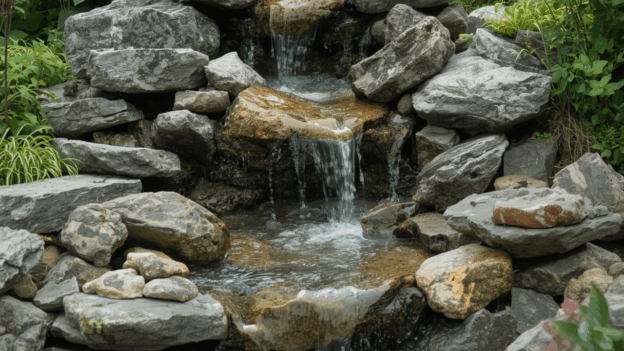
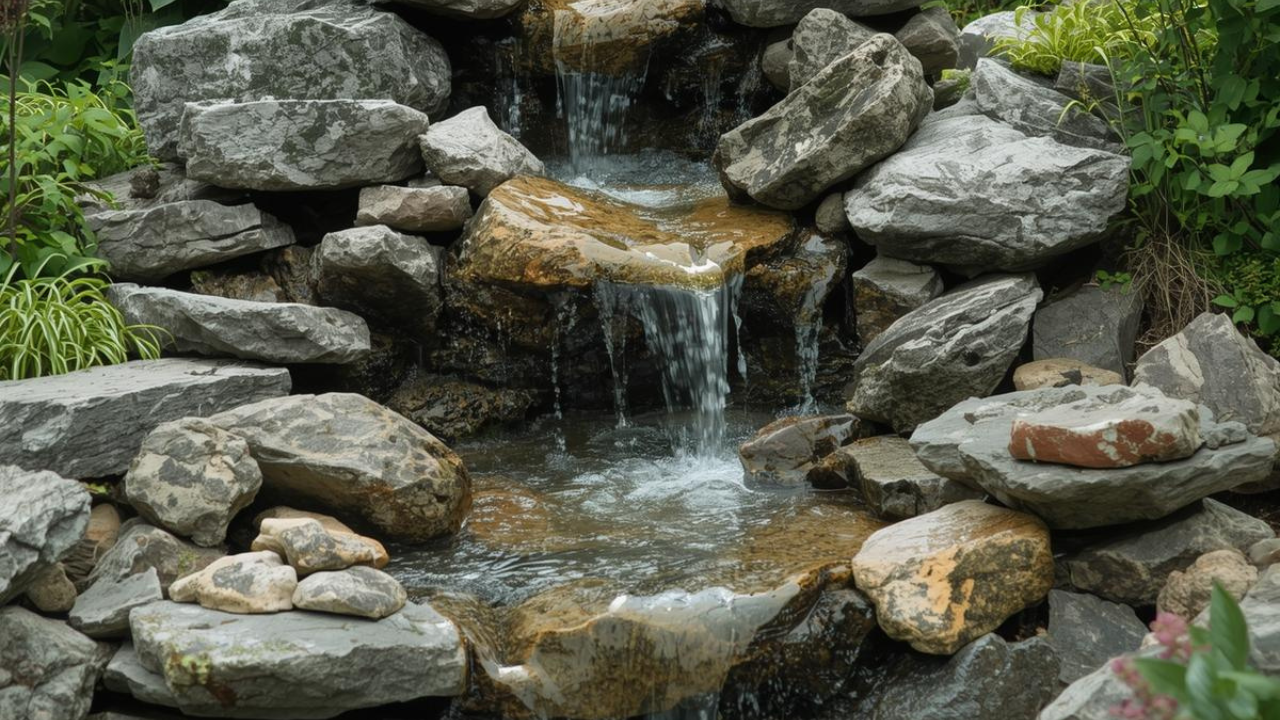
A rock garden fountain consists of natural stones with water bubbling from the center and trickling down the sides. Water disappears into a hidden underground reservoir rather than collecting in a visible basin. This creates a natural spring illusion where water seemingly vanishes into the earth.
These features blend into naturalistic landscapes through careful stone selection. Native rocks create organic appearances that look like permanent landscape elements. The compact footprint makes rock garden fountains ideal for garden water feature applications where space limits traditional options.
What makes a rock garden fountain different from other fountains?
Rock garden fountains deliver naturalistic, rustic aesthetics fundamentally different from architectural water features. The pondless design provides critical safety advantages—no open water surface means no drowning hazards for children or pets. Low splash and overspray risk keeps water contained within the feature, preventing damage to surrounding areas.
The hidden basin design reduces debris accumulation and algae growth compared to open pond configurations. Water remains largely contained within the closed system, minimizing evaporation losses. These features integrate with existing landscaping rather than dominating as standalone focal points, creating subtle ambient effects instead of dramatic visual statements.
Where are rock garden fountains most commonly installed?
Rock garden fountains perform best in naturalistic landscapes, small gardens, and residential courtyards. The design blends with native plantings and rockeries, appearing as organic landscape elements. Families with children and pets benefit from the pondless safety design—no exposed water eliminates drowning risks.
Small garden spaces accommodate these features easily due to compact underground footprints. One installation nestled among ferns and native plants attracted birds and wildlife while remaining safe for visiting grandchildren. The natural appearance made the feature look like it had always existed in the landscape rather than being a recent addition.
What components make up a rock garden fountain?
What role do rocks and stone materials play?
Natural stones native to the local region create authentic appearances. Success depends on making the feature look completely natural rather than artificially constructed. Varied rock sizes contribute to organic aesthetics—uniform stones appear artificial. Stone surface texture, size, and shape all affect water flow patterns and sound characteristics.
One installation used a moss-covered boulder sourced directly from the property, creating seamless integration with the existing landscape. Rock selection determines both visual appeal and acoustic properties. Larger stones produce different flow patterns than smaller rocks, while surface texture influences water distribution across the feature.
What pump and basin systems are used?
Hidden reservoirs use either pre-formed basins or flexible liners excavated into the ground. A submersible pump sits in a protective vault within the reservoir. The pump pushes water through a buried pipe to the rock’s top. The reservoir must hold sufficient volume to keep the pump submerged and account for evaporation.
River rocks or gravel cover the reservoir, creating the disappearing water effect. This covering acts as first-stage filtration while hiding mechanical components. Pump sizing follows the standard rule: circulate the entire reservoir volume at least once per hour.
How is plumbing concealed within the structure?
Pipes run from the pump in the underground reservoir to the top of the rock feature. All plumbing remains hidden within the rock structure and below ground level. The gravel or stone covering disguises both the reservoir and connecting pipes completely. This creates a seamless natural appearance without visible mechanical components.
The installation maintains the natural spring illusion through complete concealment of circulation equipment. Visitors see only water bubbling from rocks and disappearing into the ground—no pumps, pipes, or basins break the naturalistic aesthetic. This hidden infrastructure separates rock garden fountains from traditional features with exposed mechanical components.
How does a rock garden fountain work?
How is water pumped from the reservoir to the rock feature?
The submersible pump in the protective vault draws water from the hidden reservoir and pushes it vertically through a buried pipe to the rock’s top. The pump must overcome lift height—the vertical distance from the reservoir to where water emerges. Greater heights require stronger pumps.
Pump capacity must handle both vertical lift and desired flow rate. The straightforward circulation system proves simpler than complex waterfall installations with multiple spillway levels.
How does gravity guide water flow over stone surfaces?
Water bubbles up from the rock’s top or center point. Gravity pulls water down the rock’s sides in trickling patterns determined by stone surface texture. Smooth stones create sheet flow while rough, textured surfaces produce varied trickle patterns. The flow can be adjusted by changing rock size, shape, or pump flow rate.
Low flow settings generate 40-48 decibels with gentle trickling—subtle background sound suitable for quiet settings. High flow produces 48-58 decibels with moderate babbling that provides pleasant white noise. This adjustability allows customization to match acoustic preferences and environmental needs.
What types of rock garden fountains are commonly used?
How do bubbling rock fountains function?
Bubbling rock fountains feature water emerging from the rock’s center or top, creating gentle upward flow before trickling down the sides. These designs produce the quietest operation at 40-48 decibels average—gentle trickling suitable for intimate spaces. The ambiance rating of 7 reflects subtle background sound that doesn’t dominate the environment.
Water bubbles continuously from the central point, creating a natural spring appearance. One installation used a moss-covered boulder with water bubbling from the top, producing soothing sounds that attracted local birds. The contained flow prevents splash while maintaining visible water movement across the stone surface.
How do stacked stone or boulder fountains operate?
Stacked stone designs use multiple rocks at varied elevations rather than a single boulder. Water flows from one stone to the next in sequence, creating multiple cascade points. This arrangement increases both visual and acoustic variety.
The varied elevation levels produce more complex water movement. Multiple cascade points generate broader sound distribution. Rock arrangement can be customized to create specific flow patterns and acoustic effects.
How do spillway and cascade rock designs move water?
Higher flow rates through cascade designs reach 48-58 decibels average with moderate babbling. These configurations create pleasant white noise with an ambiance rating of 8—more pronounced than bubbling styles but still relaxed. Multiple cascades demonstrate how water features blend into landscaping with varied elevations and organic rock placement.
Natural cascade patterns emerge from intentional rock arrangement. The design creates twists and turns in the water path, mimicking natural stream flow. Flow rate adjustments control sound intensity—lower rates produce gentle trickling while higher volumes generate moderate babbling effects.
How does a rock garden fountain differ from traditional fountains?
How does water visibility differ between designs?
Traditional fountains feature visible basins collecting water in plain sight. Rock garden fountains make water disappear into hidden underground reservoirs. This creates the illusion that water vanishes into the earth. No water surface remains visible once flow returns to the reservoir.
The pondless concept eliminates all exposed water surfaces. Gravel covering hides the reservoir completely. Visitors see water emerge and disappear without seeing where it goes.
Why do rock garden fountains produce less splash?
Gentle trickling flow prevents water from escaping the collection area. Water maintains contact with rock surfaces throughout its descent, rarely becoming airborne. The gravel covering catches any minor splash that does occur. This contained design keeps water within the closed system reliably.
Low splash and overspray risk makes these features safe near furnishings and structures. Water doesn’t spray onto surrounding areas, preventing damage to nearby materials. The controlled flow suitable for families with children also protects landscaping and hardscaping from water exposure. This containment proves especially valuable in small spaces where splash would affect nearby elements.
How does structural exposure affect performance?
Hidden basins reduce debris accumulation compared to open pond designs. No exposed water surface collects falling leaves and organic matter directly. The underground reservoir receives protection from direct sunlight, limiting algae development. Gravel covering provides first-stage filtration before debris reaches the reservoir.
This reduced exposure to environmental contaminants lowers maintenance demands significantly. Open ponds collect airborne debris constantly while underground reservoirs remain protected. The design prevents most organic matter from entering the water system, maintaining cleaner water with less intervention than traditional fountain configurations.
How do pump and flow requirements affect rock garden fountains?
How is pump size determined for rock garden designs?
Pump sizing follows the general rule: circulate the entire reservoir volume at least once hourly. The relatively simple system requires less complex calculations than multi-tiered waterfalls. Submersible pumps suitable for hidden reservoir applications provide adequate capacity for most residential installations. Choosing the right fountain pump ensures reliable operation and appropriate flow characteristics.
The pump must generate sufficient power to overcome lift height from the reservoir to the rock’s top. Greater vertical distances require stronger pumps to maintain desired flow rates. Head height—the vertical distance water travels—represents the critical factor in pump selection. Efficiency decreases with increased vertical lift, requiring larger pumps for taller features.
How does lift height affect circulation efficiency?
The distance from reservoir water level to where water emerges determines required pump power. Taller features demand more powerful pumps to push water vertically against gravity. Head height directly impacts energy consumption and pump sizing requirements. Pumps work harder overcoming vertical distance than moving water horizontally.
Each additional foot of lift height reduces pump efficiency and increases electricity consumption. The pump must maintain adequate flow rate while fighting gravity throughout the vertical run. This relationship between height and power requirements influences both installation costs and ongoing operating expenses.
Why does flow rate matter more than spray pressure?
Flow rate determines sound characteristics and visual effects. Low flow generates gentle trickling at 40-48 decibels while high flow produces moderate babbling at 48-58 decibels. The trickling effect over rock surfaces requires adequate volume, not forceful pressure. Gentle flow creates natural appearances rather than artificial spray patterns.
Sound adjustment happens through flow rate control rather than pressure manipulation. Higher volumes create more pronounced water sounds without requiring high-pressure systems. This approach maintains natural aesthetics while allowing acoustic customization. The gentle flow over textured stone surfaces produces more appealing sounds than pressurized spray configurations.
What installation factors influence how a rock garden fountain works?
How does ground preparation affect stability and drainage?
Excavation for the reservoir requires proper depth and leveling. The ground must support the combined weight of rocks, water, and basin without settling. Improper preparation leads to shifting and circulation problems. Drainage around the feature prevents water pooling outside the system.
The reservoir must fit correctly within the excavated space. Proper positioning ensures the pump remains submerged. Site preparation proves critical for long-term stability.
How does stone size impact water movement?
Rock size and shape directly affect flow patterns and sound production. Larger stones create broader flow paths while smaller rocks produce narrower trickle patterns. Surface texture influences water distribution—smooth surfaces create sheets while rough textures generate varied patterns. Stone selection impacts both aesthetics and acoustic properties significantly.
Varied rock sizes contribute to natural appearances that look organic rather than artificial. The combination of different stone dimensions creates complex flow patterns mimicking natural water movement. Rock arrangement determines where water flows and how it sounds, making stone selection a critical design decision affecting long-term satisfaction.
Why does basin depth matter for proper circulation?
The reservoir must hold sufficient volume to keep the pump submerged continuously. Evaporation over time reduces water levels, requiring adequate initial depth. If water drops below the pump intake, the system fails and potentially damages the motor.
Basin capacity must account for water loss through evaporation. Adequate volume ensures the pump remains underwater between refills. Undersized reservoirs require frequent topping off and risk pump damage.
How do maintenance needs differ for rock garden fountains?
Why do rock surfaces trap debris and sediment?
Rock garden fountains require 3.5 monthly maintenance hours total: 1.5 hours routine cleaning, 0.5 hours filter/pump maintenance, 0.5 hours water quality management, and 1.0 hour seasonal tasks. Rock surfaces trap leaves and organic debris despite the hidden basin design. The gravel covering acts as filtration but requires periodic cleaning to prevent clogging.
The low to moderate maintenance classification proves significantly easier than waterfall-with-pond configurations requiring 9.0 monthly hours. However, rock surfaces still collect organic matter requiring removal. The hidden basin design reduces overall accumulation compared to open ponds, but doesn’t eliminate debris management entirely. Professional services charge $75-150 hourly, translating to $262.50-525 monthly for complete maintenance.
How does algae growth behave on stone materials?
Hidden reservoirs protected from direct sunlight experience limited algae development. Underground positioning keeps water cooler and darker, restricting algae growth. Water quality management requires only 0.5 hours monthly—far less than open pond configurations.
Natural stone may develop beneficial biofilm without becoming problematic. This differs from excessive algae plaguing open water surfaces under direct sun.
How often should pumps and reservoirs be inspected?
Filter and pump maintenance demands 0.5 hours monthly while routine cleaning takes 1.5 hours. Regular inspection prevents buildup that restricts flow and strains pump motors. The pump vault allows easy access for maintenance while keeping equipment hidden from view. Seasonal tasks averaged across the year require 1.0 hour monthly.
Periodic inspection catches problems before they cause failures. Checking pump operation, cleaning filters, and verifying water levels prevents emergency breakdowns. The accessible pump vault design simplifies maintenance compared to features requiring extensive disassembly for equipment access. Consistent attention maintains reliable operation and extends equipment lifespan through proper parts care.
How does water usage and efficiency compare in rock garden fountains?
How does recirculation limit water loss?
The closed-loop system reuses the same water continuously without drainage during normal operation. Water remains contained within the feature. Only evaporation and minimal splash create losses requiring replacement.
This recirculation proves highly efficient. The same water circulates indefinitely until lost through evaporation. Regular top-offs maintain volume but total consumption remains minimal.
How does evaporation differ from open-basin fountains?
Evaporation rates qualify as low to moderate since water remains largely contained. The hidden reservoir reduces exposed surface area. Gravel covering limits direct evaporation from the basin. Underground positioning keeps water cooler, reducing evaporation.
This contained design shows significantly lower evaporation than open pond fountains. The underground reservoir experiences less air and sun exposure driving evaporation.
How does splash loss vary by rock arrangement?
Low splash and overspray risk characterizes the trickling design. Water flows over rocks and drains directly into the gravel-covered basin below. The covering catches any minor splash before it escapes the system. Contained design prevents water from leaving the collection area during normal operation.
Well-designed features experience minimal splash loss. Rock arrangement can be optimized to direct water flow toward the basin center, further reducing escape potential. The combination of gentle flow and strategic placement keeps water within the closed system reliably. Total water loss remains limited to evaporation rather than splash or overspray.
Where do rock garden fountains perform best?
Why are rock garden fountains ideal for outdoor landscapes?
Naturalistic landscapes, small gardens, and residential courtyards provide optimal settings. The natural aesthetic integrates seamlessly with existing plantings and rockeries. Gentle babbling sounds attract birds and wildlife, creating peaceful spots for contemplation. The design blends so effectively that features appear as permanent landscape elements rather than recent additions.
Child and pet-friendly areas benefit from the pondless safety design. Families with young children or pets avoid drowning hazards completely since no exposed water exists. The compact footprint suits small spaces where traditional fountains with visible basins won’t fit. Space-efficient design allows water features in gardens too small for conventional installations.
How do sunlight and climate affect operation?
Hidden reservoirs protected from direct sunlight experience reduced algae growth. Underground positioning and gravel covering limit sun exposure. Seasonal maintenance tasks average 1.0 hour monthly across the year. Weather exposure requires seasonal considerations but the protected design minimizes impact.
Climate affects evaporation rates but the contained design limits total loss. Outdoor installation allows natural integration with native plants impossible to achieve indoors.
When are rock garden fountains less suitable indoors?
Rock garden fountains are designed specifically for outdoor naturalistic landscapes, small gardens, and outdoor courtyards. The features don’t appear in commercial lobby or indoor application recommendations. Ground excavation for hidden reservoirs proves difficult in indoor settings without major structural modifications. Natural aesthetics using native stone materials suit outdoor garden integration better than interior design.
Sound levels of 40-58 decibels suit outdoor ambient noise environments rather than quiet indoor spaces. Stone materials and naturalistic rock arrangements complement outdoor landscapes but may appear out of place in refined interior settings. The outdoor focus of these designs limits indoor applicability compared to water walls specifically engineered for interior installations.
What should be considered before installing a rock garden fountain?
How do space, maintenance, and design goals align?
Rock garden fountains fit compact footprints with hidden underground basins. Small gardens accommodate these features where traditional fountains won’t work. The 3.5 monthly maintenance hours prove manageable. Professional services cost $262.50-525 monthly—significantly less than pond waterfalls requiring $675-1,350.
Design goals emphasizing naturalistic aesthetics benefit from rock garden fountains. The features blend with landscaping rather than dominating as architectural statements. Child and pet safety considerations favor pondless designs. Wildlife attraction through gentle sounds enhances landscape ecology.
When is professional planning recommended?
Professional installation ensures proper reservoir sizing and adequate pump selection for lift heights. Expert guidance optimizes landscape integration and natural appearance. Proper ground preparation requires expertise preventing future settling and stability issues. Rock placement for authentic natural aesthetics often needs skilled design eyes.
Plumbing and electrical work benefit from professional execution. Features built to last require proper drainage, stability, and circulation design. The initial investment in professional planning prevents costly corrections later. Expert installation delivers reliable operation and authentic appearances that DIY attempts often fail to achieve.
What is the next step in selecting a rock garden fountain?
Assess whether your property qualifies as a naturalistic landscape, small garden, or residential courtyard. Evaluate child and pet safety needs. Determine sound preferences: gentle trickling (40-48 dB) or moderate babbling (48-58 dB). Budget planning targets $500-2,500 range with $1,500 typical.
Evaluate maintenance capacity for DIY versus professional service. Measure installation areas to assess space requirements. Review local regulations. Consider whether natural aesthetic fits overall property design. Consult professionals for design integration ensuring authentic appearance.
Create Your Natural Oasis With Expert Installation
Rock garden fountains deliver natural aesthetics, compact footprints, and safe pondless designs. The 3.5 monthly maintenance hours and $1,500 typical cost make these accessible. However, improper installation creates ongoing problems—inadequate reservoir sizing, poor drainage, and artificial-looking rock placement.
Orange County Pond Services specializes in rock garden fountain design creating authentic appearances. Our team handles ground preparation, reservoir sizing, pump selection, and natural stone placement. We ensure proper drainage, adequate circulation, and reliable operation. Contact us for professional consultation and discover how a rock garden fountain can transform your landscape into a natural retreat.
