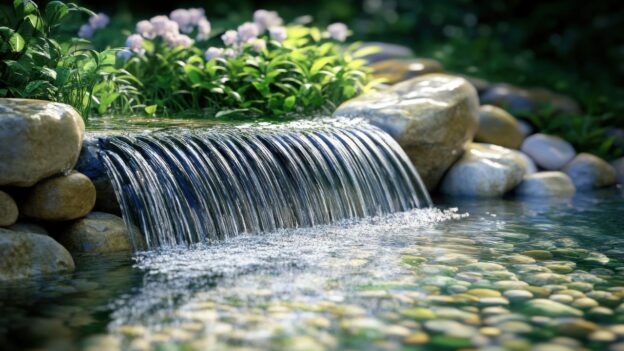
Outdoor waterfalls typically recirculate the same water through a pump, basin, and stream path rather than consuming continuous new water. Ongoing waterfall water usage comes from replacement water added to compensate for evaporation, splash-out, leaks, cleaning, and filter maintenance. Understanding the difference between held water volume and consumed water helps homeowners estimate refill frequency, identify leaks, and control pump electricity costs for recirculating systems.
This article explains how to calculate outside waterfall volume, estimate evaporation and splash loss by exposed surface area, compare pump energy consumption, diagnose leaks using isolation techniques, and implement water-efficiency practices. Orange County homeowners can use these formulas and examples to evaluate total running costs and make informed design and maintenance decisions for outdoor waterfalls, ponds, and fountains.
Key Takeaways
- Outdoor waterfalls recirculate water, so ongoing consumption comes from evaporation, splash, leaks, and cleaning rather than continuous new water flow.
- Exposed surface area drives routine evaporation; one inch of water over 100 square feet equals about 62.3 gallons.
- Pump electricity is often the most predictable running cost, calculated as wattage × hours ÷ 1,000 to determine kilowatt-hours.
- Sudden or large water loss indicates a leak, liner damage, or splash-control problem, not normal evaporation.
- Water-efficient design requires right-sized pumps, controlled landing zones, clean filters, shade where practical, and regular inspection.
What Is the Difference Between Held Water and Consumed Water in Outdoor Waterfalls?
Held water refers to the total gallons sitting in the pond, reservoir, basin, and stream path at any given time. Consumed or replacement water is the volume added later to compensate for evaporation, splash-out, leaks, cleaning, filter service, or intentional water changes. Most outdoor waterfalls recirculate the same water through a basin, pond, streambed, or reservoir rather than draining to waste. Pondless waterfalls use a hidden basin or reservoir without an exposed pond surface, reducing visible evaporation area but still requiring periodic refills.
How Is Outside Waterfall Volume Calculated?
Calculate water volume using the formula: cubic feet × 7.48 equals gallons. A 6 ft × 4 ft basin with 1 ft average water depth equals 24 cubic feet, or about 179.5 gallons before rock and pump displacement. A 10 ft × 2 ft stream with 0.25 ft (3 inches) average moving-water depth equals 5 cubic feet, or about 37.4 gallons. Rock and pump displacement reduce actual water volume below the calculated basin volume.
One inch of water over one square foot equals about 0.623 gallons, a useful conversion for evaporation math. This formula applies to basins, ponds, reservoirs, and stream sections regardless of waterfall height. Accurate volume calculation helps homeowners estimate initial fill requirements and track whether water loss exceeds normal evaporation and splash rates.
What Causes Water Consumption in Recirculating Systems?
Held water remains in the system as long as the pump runs and no leaks exist. Consumed or replacement water must be added because of evaporation, splash-out, wind drift, leaks, cleaning, filter service, or intentional water changes. Pondless waterfalls still lose water through splash and drift despite their reduced evaporation area.
How Do Evaporation and Splash Affect Water Loss in Outdoor Waterfalls?
Evaporation and splash together account for most routine water loss in properly functioning outdoor waterfalls. Exposed surface area, weather conditions, turbulence, and splash patterns determine how quickly the system requires refilling. Understanding the relationship between surface area and evaporation rate helps homeowners estimate monthly replacement needs and distinguish normal loss from potential leaks.
How Does Exposed Surface Area Influence Evaporation Rates?
Exposed surface area determines how much water a feature loses to evaporation. The table below shows water loss per inch of evaporation across common surface areas.
| Exposed Surface Area (sq ft) | Water Loss per 1 Inch of Evaporation (gallons) |
|---|---|
| 10 | 6.2 |
| 25 | 15.6 |
| 50 | 31.2 |
| 100 | 62.3 |
These calculations use the USGS conversion that one inch of water over one square foot equals approximately 0.623 gallons. Larger exposed pond surfaces lose more water than smaller pondless basins under identical weather conditions. Homeowners can multiply their feature’s exposed square footage by 0.623 and then by the estimated inches of loss to project refill needs.
What Role Do Weather and Environmental Conditions Play?
Evaporation is the process that changes liquid water to gaseous water vapor. Wind drives evaporation by sweeping away humid air above the water surface, allowing dry air to replace it. Sun exposure accelerates evaporation and can drive pumps to work harder to maintain flow rate. Turbulence and splash increase evaporation rates measurably by exposing more water surface area to air.
Aeration effects accelerate evaporation, particularly in hot, dry climates typical of Southern California summers. Waterfall systems with high turbulence or splash landing on rocks lose more water than those with smooth pool landings. Proper pond pump maintenance ensures the system operates efficiently without excessive flow that increases splash loss.
When Does Water Loss Indicate a Leak in a Waterfall System?
Normal evaporation and splash cause gradual, weather-dependent water loss measured in inches over days or weeks. Large or sudden water loss indicates a leak in the liner, plumbing, basin, or waterfall structure. Distinguishing between normal consumption and leaks requires observation, isolation testing, and systematic inspection of all water-holding components.
How to Diagnose Leaks Using Isolation and Observation Techniques
Run a temporary pipe from your water pump to your stream’s first waterfall or shelf to isolate the leak. Allow at least 24 hours for the water to flow normally through your temporary line and observe whether the basin level remains stable. If there is no evidence of water loss, conclude that the bottom shelf or waterfall is not leaking. When you’ve found the leak, cut out the damaged section of the pipe and replace it.
Keep the pump submerged during testing to prevent burnout from running dry. Move the temporary line progressively upstream to isolate each waterfall section and stream segment. This systematic approach identifies the exact location of liner punctures, plumbing failures, or structural leaks without draining the entire system.
What Are Common Signs of Leaks Versus Normal Evaporation?
Normal evaporation and splash loss are gradual and weather-dependent; large or sudden water loss indicates a leak. Liner edges below grade or water leeching over the liner edge can cause water loss that appears similar to evaporation. Punctures or holes in liners cause leaks that drain the basin faster than evaporation rates justify. Buried plumbing lines may not show wet areas on the surface when leaking, making isolation testing necessary.
Auto-fill systems can hide leaks if no one monitors total water usage or observes float-valve activity. Homeowners should check water level daily for several days after installation or repair to establish a baseline evaporation rate. Comparing observed loss against calculated evaporation for the exposed surface area reveals whether further leak investigation is needed.
How Much Energy Does the Waterfall Pump Consume and What Are the Running Costs?
Pump energy consumption often represents the most predictable running cost for outdoor waterfalls. Electricity usage depends on pump wattage, daily operating hours, and local electricity rates. Understanding kilowatt-hour calculations and comparing pump-size options helps homeowners estimate monthly bills and select appropriately sized equipment.
How to Calculate Pump Electricity Usage and Monthly Costs
Pump electricity use is calculated as wattage multiplied by hours, divided by 1,000, to find kilowatt-hours (kWh). The EIA June 2026 California average electricity prices are 34.74 cents per kWh residential and 27.33 cents per kWh commercial. The table below shows monthly electricity use and cost for common pump sizes running 24/7 for 30 days.
| Pump Wattage | Monthly kWh (24/7, 30 days) | Residential Cost (34.74¢/kWh) | Commercial Cost (27.33¢/kWh) |
|---|---|---|---|
| 50W | 36.0 kWh | $12.51 | $9.84 |
| 100W | 72.0 kWh | $25.01 | $19.68 |
| 150W | 108.0 kWh | $37.52 | $29.52 |
| 250W | 180.0 kWh | $62.53 | $49.19 |
Real bills vary by utility, rate plan, taxes, time-of-use schedule, and pump duty cycle. Homeowners should multiply pump wattage by 24 hours, then by 30 days, then divide by 1,000 to calculate monthly kWh. Multiplying monthly kWh by the local electricity rate provides an estimated cost before taxes and plan-specific adjustments.
How Do Pump Size and Waterfall Head Height Affect Energy Consumption?
Higher head heights require more powerful pumps, creating higher energy draw that compounds over time. Oversized pump flow increases both electricity consumption and water loss from excessive splash and turbulence. Using a smaller pump that matches the waterfall design reduces electricity consumption without sacrificing visual or auditory appeal.
Comparing pump options during design prevents overspending on electricity while maintaining desired flow rates. Choosing between a fountain or waterfall involves evaluating pump requirements and total energy consumption alongside aesthetic preferences.
What Design and Maintenance Practices Improve Water Efficiency for Outdoor Waterfalls?
Water efficiency in outdoor waterfalls depends on thoughtful design choices and consistent maintenance practices. Splash control, shade placement, auto-fill management, and regular cleaning all reduce unnecessary water loss and energy consumption. Homeowners can implement multiple strategies to lower operating costs without compromising the visual impact or relaxing sound of moving water.
How Can Splash Control and Shade Reduce Water Loss?
Adjust stone placement and splash shelves to keep water landing inside the basin rather than on surrounding surfaces. Placing the water feature in shade reduces evaporation and reduces pump workload by lowering water temperature. Water landing on stones or boulders creates more splash loss than water landing directly into a deep pool. Waterfalls cannot be covered while operating, unlike pools, making splash control and shade the primary evaporation-reduction strategies.
Turbulence and splash increase evaporation rates measurably, so smooth-flow designs lose less water than highly turbulent cascades. Homeowners should observe splash patterns during windy conditions and adjust stone angles or waterfall lip positions accordingly. Regular pond fountain maintenance includes checking that splash patterns remain controlled as rocks settle or shift over time.
What Are the Benefits and Caveats of Auto-Fill Systems?
Auto-fill systems prevent pumps from running dry and eliminate manual refilling, but they require careful setup and monitoring. One Orange County Pond Services client article notes that auto-fill setups may use less than 5 gallons per week in some sunny-location examples. Pairing auto-fill with a slow-drip overflow drain prevents flooding if the float valve sticks open. Using a sediment pre-filter or water filter reduces mineral buildup when auto-fill systems introduce municipal tap water continuously.
Float valves can stick and cause flooding without an overflow drain safety measure. Auto-fill can hide leaks if no one monitors total water usage or inspects the float-valve operation regularly. Homeowners should verify that auto-fill systems maintain the correct basin level without masking underlying plumbing or liner problems that require addressing a leak.
How Does Regular Maintenance Impact Water and Energy Use?
Clean the pump and filtration system thoroughly at least every couple of weeks to maintain efficient water circulation. Check water level frequently to ensure the pump and filtration system remain covered with water and do not burn out. After wind events, check the fountain and pond for debris that may clog the pumps and reduce efficiency. Low water level can expose and burn out pumps, requiring expensive replacement and causing system downtime.
Clogged filters force pumps to work harder, increasing electricity consumption and accelerating equipment wear. Regular cleaning prevents algae buildup that reduces water clarity and increases maintenance frequency. Professional maintenance services for outdoor water fountains typically include pump inspection, filter cleaning, water-quality testing, and leak checks during each visit.
How Do Pools and Ponds Compare to Outdoor Waterfalls in Water Usage and Efficiency?
Pools and ponds differ from outdoor waterfalls in surface area, circulation requirements, and usage patterns. Decorative pondless waterfalls may have different oxygen and circulation needs than koi ponds with fish that require continuous aeration, and unlike pools, waterfalls cannot be covered to cut evaporation during non-use periods. Comparing water features requires evaluating exposed surface area, pump run time, splash loss, and ecosystem requirements rather than assuming all water features consume water at identical rates.
Koi ponds with waterfalls combine higher exposed surface area with continuous pump operation to maintain fish health and water quality. Fountain-only designs typically lose less water to splash than waterfalls but may have comparable evaporation rates based on total basin surface area. Understanding these differences helps property owners select and maintain water features that align with their aesthetic preferences, maintenance capacity, and utility budget.
Practical Considerations for Orange County Homeowners Considering Outdoor Waterfalls
Orange County homeowners should evaluate waterfall water usage, energy consumption, and maintenance requirements before installation or renovation. Local climate conditions include hot, dry summers with low humidity that accelerate evaporation and increase refill frequency. Pairing realistic consumption estimates with professional design guidance ensures that outdoor waterfalls remain enjoyable features rather than unexpected cost burdens. Consulting experienced professionals helps homeowners size pumps appropriately, control splash patterns, and implement water-saving strategies for outdoor ponds.
Orange County Pond Services provides design consultation, installation, maintenance, and repair services throughout Orange County and Southern California. Homeowners can contact the team at 949-653-2305, Monday through Friday from 9:00 AM to 5:00 PM. The service area includes all of Orange County, with the office located at 5102 Bayonne Cir, Irvine, CA 92604.
Water Usage and Running Costs of Outdoor Waterfalls Synthesized: Balancing Volume, Loss, Energy, and Efficiency
Outdoor waterfalls use water through initial system volume and ongoing replacement for evaporation, splash, leaks, and maintenance. Calculating held volume requires multiplying basin dimensions by 7.48 to convert cubic feet to gallons, while estimating replacement needs requires multiplying exposed surface area by 0.623 gallons per square foot per inch of loss. Real monthly water bills vary by utility, rate plan, taxes, exposed surface area, and leak status. Exact monthly water requirements depend on the homeowner’s surface area, local utility rate, evaporation period, and whether leaks exist.
Energy consumption from pumps often exceeds water costs as the primary predictable expense. Evaporation rate depends on local weather, wind, humidity, and sunlight exposure throughout the season. Homeowners who understand these variables can design and maintain outdoor waterfalls that deliver aesthetic and auditory benefits without excessive resource consumption. Properly sized pumps, controlled splash zones, regular maintenance, and prompt leak repair create water-efficient systems that enhance property value and outdoor living spaces.
Incorporating waterfalls into existing pond designs requires evaluating pump capacity, circulation needs, and splash-control strategies to balance visual impact with efficient operation. Professional assessment identifies opportunities to reduce water loss, lower electricity costs, and improve system reliability. Orange County homeowners seeking expert guidance on waterfall design, installation, or maintenance can explore comprehensive professional services that address both aesthetic goals and long-term operating efficiency.
Contact Orange County Pond Services for Your Free Quote
A recirculating waterfall should bring calm to your yard, not a mystery on your water bill. Our team has maintained pumps, basins, and stream paths across Orange County and Southern California for over 25 years, and knows the difference between normal evaporation and a leak.
If you want a second opinion on rising water usage or help sizing a more efficient pump, contact Orange County Pond Services for a free quote. Call us at 949-653-2305, Monday through Friday from 9:00 AM to 5:00 PM, or request your free quote online today.
Frequently Asked Questions About Outdoor Waterfall Water Usage
Q1. How much water does an outdoor waterfall use per month?
A. Monthly water use for an outdoor waterfall depends mainly on exposed surface area and weather rather than a fixed number of gallons. Homeowners can multiply their feature’s exposed square footage by 0.623 gallons, then by the estimated inches of monthly loss, to project a realistic refill volume. Most well-designed systems lose water gradually through evaporation and splash rather than through a continuous drain-to-waste flow.
Q2. Does a pondless waterfall use less water than a pond with a waterfall?
A. Pondless waterfalls use a hidden basin or reservoir instead of an exposed pond surface, which reduces direct evaporation compared to a koi pond or garden pond of similar size. Water loss still occurs through splash, drift, and filter maintenance, so a pondless system is not water-free even without visible surface area. Homeowners comparing options should weigh exposed surface area, circulation needs, and ecosystem requirements rather than assuming one feature type uses no water.
Q3. How can I tell if my waterfall has a leak instead of normal water loss?
A. Normal evaporation and splash loss happen gradually and track with weather, while a leak causes sudden or unusually large drops in water level. Isolating sections of the stream with a temporary pump line, then watching the basin level over 24 hours, helps pinpoint whether a shelf, liner, or plumbing section is losing water. Liner edges below grade and buried plumbing can leak without any visible wet area on the surface, so isolation testing is often necessary even when nothing looks wrong.
Q4. What size pump keeps electricity costs down without sacrificing performance?
A. Pump electricity cost scales directly with wattage, so choosing a pump sized to a waterfall’s head height and flow needs keeps monthly costs predictable. Oversized pumps increase both energy draw and water loss from excess splash, so a bigger pump is not automatically the right choice for a waterfall’s design. An experienced pond and fountain specialist can match pump size to head height and flow rate so the feature performs well without running up unnecessary costs.
Q5. How often should I check my outdoor waterfall to avoid water waste?
A. Checking water level daily for the first several days after installation or repair establishes a baseline evaporation rate that makes future changes easier to spot. Cleaning the pump and filtration system every couple of weeks keeps circulation efficient, since clogged filters make pumps work harder and can accelerate water loss. Homeowners using auto-fill systems should still monitor total water usage periodically, since auto-fill can mask a developing leak if no one tracks it.
