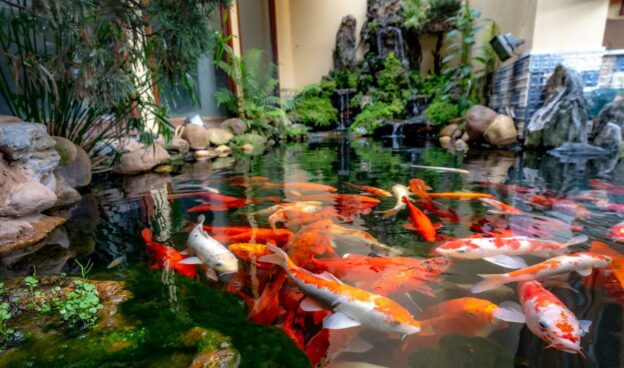
Submersible vs. external pond pumps is the first decision most owners face when a pump fails or a new water feature goes in. Pond pumps function as the circulation engine driving water movement, filtration, and oxygen distribution throughout your water feature. The wrong pump selection can lead to weak flow, cloudy water, green water, stressed fish, higher electricity use, and repeated repairs.
Below, you’ll find a direct comparison of both pump types across purchase price, energy consumption, maintenance access, lifespan, and algae-control effectiveness. Orange County Pond Services has sized, installed, and repaired pond and fountain pumps across Southern California since 2001, so the figures here reflect service calls rather than catalog ratings. Understanding these differences helps pond owners make practical decisions based on pond size, fish load, waterfall height, and how long a pond pump should last.
Key Takeaways
- Submersible pumps usually cost less upfront but may have a shorter service life, ranging from 2–5 years.
- External pond pumps cost more initially but can last 10–15 years with easier maintenance access.
- Pump performance directly affects UV and filter effectiveness, making proper flow essential for algae control.
- Energy cost depends on wattage, runtime hours, and local electricity rates rather than pump type alone.
- Professional pump selection considers pond volume, fish load, waterfall height, filtration needs, and maintenance preferences.
Submersible vs External Pond Pumps: How Each Type Moves Water
Submersible pumps operate completely underwater within the pond or skimmer basin while external pumps sit outside the water. Both pump types move water through filters and features, but installation requirements and operational characteristics differ significantly.
Submersible Pump Operation Underwater
Submersible pumps are hidden underwater in the pond or basin where they draw water directly through intake screens. Mag-drive pumps are a type of submersible pump that uses magnetic coupling to transfer motor power to the impeller.
External Pond Pump Operation Outside the Water
External pumps sit outside the pond and require plumbing and priming to draw water from the pond into the pump chamber. Centrifugal pumps are a type of external pump that uses rotational energy to move water through the system.
Key Components and Installation Differences
Submersible pumps are hidden and less visible, while external pumps are more visible and need placement planning for weather protection. External pumps need proper installation, plumbing, priming, and weather-safe placement, whereas submersible pumps have simpler DIY installation requirements.
| Design factor | Submersible pump | External pond pump |
|---|---|---|
| Placement | Sits underwater in the pond or skimmer basin | Sits outside the water in a dry, weather-protected spot |
| Installation | Simple DIY drop-in with minimal plumbing | Plumbing, priming, and placement planning required |
| Drive type | Mag-drive, magnetic coupling to the impeller | Centrifugal, rotational energy moves the water |
| Visibility | Hidden from view | Visible, needs screening or an equipment pad |
| Common use | Small decorative fountains and compact ponds | Larger koi ponds, biological filters, and high-head waterfalls |
Submersible vs External Pond Pumps: Performance Factors That Change Flow
Flow rate decreases as water moves vertically and encounters resistance from pipes, elbows, filters, and UV units. Rated gallons per hour rarely matches actual delivered flow after accounting for these system variables.
Flow Rate and Head Height Determine Pump Output
Head height is the vertical lift required for water movement from the pond surface to the discharge point. Rated GPH is not the same as delivered GPH after accounting for head height, pipe resistance, and filter resistance.
Delivered GPH Versus Rated GPH
Actual flow changes with vertical lift, head height, pipe diameter, elbows, clogged pre-filters, debris load, and filter or UV resistance. A pump rated at 4,000 GPH may deliver only 2,500 GPH when pumping water eight feet vertically through plumbing.
Pump Performance Effects on Filtration and Algae Control
A pump that is too weak may leave stagnant zones and fail to move enough water through the filter or UV system. A pump that is too strong for a UV unit can move water too quickly, reducing exposure time.
Stagnant zones can contribute to algae growth, while weak flow reduces UV clarifier effectiveness against suspended algae. Wrong pump selection can lead to weak flow, cloudy water, green water, stressed fish, higher electricity use, and repeated repairs.
Upfront Price and Lifetime Cost Comparison
Purchase price represents only the initial investment, while total ownership cost includes replacement frequency, energy consumption, and maintenance expenses. Lifecycle cost analysis reveals which pump type delivers better long-term value for specific pond applications.
Typical Purchase Price Ranges
Submersible mag-drive pumps cost approximately $80–$600 depending on flow capacity and features. External centrifugal pumps cost approximately $400–$3,500, reflecting higher initial investment for commercial-grade construction.
Pump Lifespan and Total Ownership Cost
Submersible mag-drive pond pumps typically last 2–5 years under normal operating conditions and maintenance schedules. External centrifugal pond pumps can last 10–15 years when properly installed and maintained regularly.
Repeated pump replacements can exceed the cost of a properly sized system when homeowners replace low-cost units every two years. A $200 submersible pump replaced four times over eight years costs $800 versus one $600 external pump lasting the entire period. Weighing a pump repair against a replacement at the first failure keeps that cycle from repeating.
| Cost factor | Submersible mag-drive | External centrifugal |
|---|---|---|
| Purchase price | $80 to $600 | $400 to $3,500 |
| Typical service life | 2 to 5 years | 10 to 15 years |
| Replacements in 10 years | 2 to 5 units | 0 to 1 unit |
| Eight-year example | $200 unit replaced four times: $800 | One $600 unit for the full period |
| Service access | Pull the unit from the water each time | Above-ground access without draining |
Expected Maintenance Expenses and Service Frequency
Weekly pre-filter cleaning can extend pump life from around 2 years to 5–7 years by preventing debris from damaging impellers. Repair costs exceeding 50% of a new pump’s price are a practical replacement threshold for most pond owners.
Dirty or aging systems can require pump replacements every 18–24 months when maintenance protocols are inconsistent or inadequate. Regular cleaning schedules reduce emergency replacement costs and extend equipment service life substantially.
Energy Use and Monthly Operating Costs
Electricity consumption depends on pump wattage, daily runtime hours, and local utility rates rather than pump type alone. Continuous operation common in pond systems makes energy efficiency a significant long-term cost factor.
Energy Consumption Formula for Pond Pumps
Calculate energy cost by dividing pump wattage by 1,000, then multiplying by hours per day, days per month, and local kWh rate. A 200-watt pump running 24 hours per day uses 4.8 kWh per day under continuous operation.
Monthly use at 30 days equals 144 kWh for a 200-watt pump running continuously throughout the billing period. Multiplying monthly kWh by your utility’s cost per kWh reveals actual operating expense for comparison purposes.
| Pump wattage | Daily kWh at 24 hours | Monthly kWh at 30 days | Example monthly cost at $0.30 per kWh |
|---|---|---|---|
| 100 watts | 2.4 kWh | 72 kWh | $21.60 |
| 200 watts | 4.8 kWh | 144 kWh | $43.20 |
| 350 watts | 8.4 kWh | 252 kWh | $75.60 |
| 500 watts | 12.0 kWh | 360 kWh | $108.00 |
Wattage and Runtime Differences Between Pump Types
External pumps often deliver higher flow rates per watt consumed compared to submersible pumps in equivalent flow ranges. Properly sized pumps matched to actual system requirements consume less energy than oversized units working against excessive head pressure.
Efficiency Practices That Reduce Energy Costs
Exact monthly energy cost varies by wattage, runtime, head height, utility rate, and plumbing resistance across different pond configurations. Reducing head height, minimizing elbows, using larger diameter pipe, and cleaning filters regularly all improve pump efficiency.
Maintenance Access and Repair Differences
Maintenance frequency affects long-term cost and convenience regardless of initial pump purchase price or efficiency ratings. Access differences between submersible and external pumps influence how quickly owners can diagnose problems and perform routine cleaning.
Submersible Pump Access for Cleaning and Repairs
Submersible pumps must be pulled from water for service, while external pumps have easier above-ground access for inspection. You must pull the submersible pump from the pond or basin for inspection or cleaning tasks.
Maintenance Advantages of External Pumps
You can access external pumps above ground for inspection or service without draining water or reaching into the pond. This above-ground positioning simplifies routine maintenance tasks and reduces service time for busy homeowners.
Maintenance Effects on Pump Longevity
Weekly pre-filter cleaning can extend pump life from around 2 years to 5–7 years by preventing impeller damage and motor strain. A flow drop greater than 30% after cleaning indicates pump mechanical failure requiring replacement rather than additional cleaning.
Amp-draw increase greater than 30% from baseline signals imminent motor failure and urgent replacement to prevent complete system shutdown. Pumps and filtration systems should be cleaned at least every couple of weeks thoroughly to prevent clogging and reduced performance. When flow drops with no visible debris, troubleshooting the pump before replacing it often isolates a wiring, impeller, or intake problem.
Keep pump and filter systems covered with water to prevent burnout, since running equipment low or dry damages motors immediately. Regular cleaning and water-level monitoring represent the most cost-effective maintenance practices for extending pump service life.
Pump Selection by Pond Size, Fish Load, and Waterfall Height
Pond size, fish population, waterfall height, and maintenance preferences determine which pump type delivers better long-term value. Neither pump type is universally superior across all applications and budgets.
Scenarios That Favor Submersible Pumps
Small decorative fountains typically use submersible pumps due to compact size and simple installation without external plumbing. Compact ponds typically use submersible pumps when aesthetic concerns favor hidden equipment and low flow rates suffice.
Submersible pumps fit small ponds and decorative fountains where energy efficiency and long-term cost matter less than initial affordability. These applications rarely involve high head pressure or continuous heavy-duty operation stressing submersible pump components.
Situations That Make External Pumps More Cost-Effective
Larger koi ponds often use external pumps to circulate high volumes through biological filters and UV clarifiers efficiently. High-head waterfalls often use external pumps because they maintain flow rates better than submersible units when lifting water vertically.
External pumps fit larger ponds and high-flow systems where upfront cost is offset by longer lifespan and easier maintenance access. Koi pond owners prioritizing fish health often choose external pumps for reliable circulation supporting filtration and oxygen levels. Stocking density and feeding load in a koi pond raise the biological demand that a pump and filter have to carry.
Pond Size, Fish Load, and Water Feature Height in Selection
The total pond system should circulate full pond volume 4–6 times per hour for adequate filtration and oxygen distribution. A 1,000-gallon pond may require 4,000–6,000 GPH to circulate 4–6 times per hour after accounting for head height and resistance.
| Pond setup | Pump type that usually fits | Reason |
|---|---|---|
| Container pond or small decorative fountain | Submersible | Low flow demand, no external plumbing, hidden equipment |
| 500 to 1,000 gallon garden pond, low waterfall | Either type | Flow demand is modest, so budget and access preference decide |
| 1,500-gallon or larger koi pond with biological filter and UV | External | High continuous volume, better flow per watt, easier service |
| Waterfall above six feet of head height | External | Flow holds up better against vertical lift and pipe resistance |
Pump Selection and Algae Control Work Together
Pump flow rate directly affects how well filters and UV clarifiers control suspended algae and maintain water clarity. Insufficient circulation allows algae to multiply faster than filtration systems can remove it from the water column.
Proper Flow Keeps UV Units and Filters Effective
Water should pass through the UV unit at least once every 2–3 hours for effective clarification of free-floating algae. A pump that is too weak may leave stagnant zones and fail to move enough water through the filter or UV system.
A pump that is too strong for a UV unit can move water too quickly, reducing exposure time below effective treatment duration. Matching pump flow to UV capacity and filter specifications ensures algae-control equipment operates within design parameters.
Common Misconceptions About Pump Strength and Algae
UV clarification targets free-floating planktonic algae only and does not remove string algae or sediment from water. UV has zero effect on string algae, attached growth, or suspended sediment requiring mechanical filtration or manual removal.
UV clarifiers have zero effect on string algae, attached growth, or suspended sediment that cling to surfaces or settle to the pond bottom. A stronger pump alone will not fix algae without filtration, UV sizing, debris and nutrient control, cleaning, and balanced water chemistry.
Maintenance and Nutrient Control Alongside Pump Performance
Algae prevention also depends on nutrient control, debris removal, filtration, beneficial bacteria, sunlight exposure, and routine maintenance beyond pump capacity. A clogged pre-filter can make a healthy pump appear weak by restricting intake flow before water reaches the impeller.
Proper filtration system selection addresses mechanical filtration, biological processing, and UV clarification as integrated components rather than isolated equipment. Pump performance supports these systems but cannot compensate for undersized filters or neglected maintenance schedules.
Submersible Vs. External Pond Pumps: Practical Guidance for Cost-Effective and Reliable Ownership
Choosing between submersible and external pond pumps requires balancing upfront cost against lifetime value, maintenance access, and system performance requirements. Small decorative features benefit from affordable submersible pumps, while larger koi ponds justify external pump investment through longevity and serviceability.
Total ownership cost includes purchase price, energy consumption, replacement frequency, maintenance expenses, and algae-control effectiveness over years of operation. Professional pump selection considers actual pond volume, fish load, waterfall height, filtration capacity, UV requirements, and debris load rather than guessing from rated GPH alone.
Orange County Pond Services has helped Southern California pond owners select properly sized pumps and compare algae control methods since 2001. Correct pump sizing prevents weak flow, equipment failures, green water, and repeated emergency replacements that exceed planned budgets.
Pump Selection Support from Orange County Pond Services
Choosing between a submersible and an external pond pump gets easier when someone measures your actual head height, pipe runs, filter resistance, and fish load instead of reading a rated GPH figure off the box. Our team has sized, installed, and repaired pond and fountain pumps across Orange County and Southern California since 2001, and we stock replacement pumps, custom filtration units, and UV sterilizers for most residential and commercial water features. We also carry parts for homeowners who handle their own maintenance and only need a second opinion on sizing.
If your pump is short-cycling, running hot, losing flow, or simply due for replacement, contact Orange County Pond Services for a free quote. Call 949-653-2305 or request your quote online, and we will walk through the pump size, filtration match, and maintenance schedule that suits your pond. You can also review our full range of pond and fountain services before you get in touch.
Frequently Asked Questions
Q1. Which pump type is cheaper to run over ten years?
A. External centrifugal pumps usually cost less across a ten-year window even though they cost more to buy. A $200 submersible unit replaced every two to three years reaches $800 or more in that period before any energy cost is counted. External pumps also tend to deliver more flow per watt in the same flow range, which lowers the monthly electricity bill. The math swings back toward submersible pumps on small fountains and container ponds where flow demand and runtime are both low.
Q2. Can a submersible pump handle a tall waterfall?
A. A submersible pump can feed a waterfall, but output drops quickly as vertical lift increases. A unit rated at 4,000 GPH may deliver closer to 2,500 GPH at eight feet of head once pipe friction and elbows are counted. External centrifugal pumps hold their flow curve better at height, which is why waterfalls above six feet usually run on external units. Check the manufacturer’s head-height chart at your actual lift rather than the headline GPH number.
Q3. How often should a pond pump be cleaned?
A. Clean the pre-filter or intake screen weekly through the warm months when debris and algae load are highest. Pumps and filtration systems should get a thorough cleaning at least every couple of weeks to prevent clogging and flow loss. Weekly pre-filter attention can extend service life from around two years to five to seven years by keeping debris away from the impeller. A clogged pre-filter also makes a healthy pump look weak, which leads owners to replace equipment that did not need replacing.
Q4. What size pump does a 1,000-gallon koi pond need?
A. Plan to circulate the full pond volume four to six times per hour, which puts a 1,000-gallon pond in the 4,000 to 6,000 GPH range. That figure is delivered flow rather than rated flow, so account for head height, pipe diameter, elbows, and filter or UV resistance before choosing a model. Heavier fish loads and feeding schedules push the requirement toward the upper end of that range. Flow also has to match the UV unit, since water should pass through it at least once every two to three hours.
Q5. Will a stronger pump clear a green pond?
A. A stronger pump on its own will not clear green water. UV clarification targets free-floating planktonic algae and has no effect on string algae, attached growth, or suspended sediment. Flow that is too fast for the UV unit reduces exposure time and lowers treatment effectiveness, so oversizing can make clarity worse rather than better. Clear water depends on correct pump sizing combined with filtration capacity, UV sizing, nutrient and debris control, beneficial bacteria, and a regular cleaning schedule.
