
Key Takeaways:
- The 10 GPM per linear foot rule determines flow requirements for sheet flow spouts achieving 1/4-inch deep water sheets—undersizing causes noisy fluttering and uneven coverage.
- Mounting height of 12-18 inches provides pleasant sound without excessive overspray while basin width must be at least twice the waterfall’s drop height for splash control.
- 316 marine-grade stainless steel offers superior corrosion resistance for all climates while copper develops blue-green patina without staining porous stone surfaces.
- Narrow openings and complex internal structures (nozzles) require more maintenance and clog easier than simple wide spillway and scupper designs.
- Always select pumps exceeding minimum GPM requirements and install ball valves for fine-tuning—better to dial down oversized pumps than struggle with undersized units.
Wall fountain spouts control water delivery and determine visual character and acoustic performance. The spout shapes water flow—smooth sheets, cascading waterfalls, or directed streams. Selection balances aesthetics, material durability, and flow physics.
This guide explains spout types, material performance, flow requirements, and pump compatibility. You’ll learn the 10 GPM per foot formula, mounting heights, basin sizing rules, and material selection criteria.
What is a wall fountain spout?
How does a wall fountain spout control water delivery?
The spout is the fountain’s heart, defining visual character and acoustic profile. It controls the water pattern as water exits the delivery system. Flow patterns depend on spout opening shape, size, and internal structure.
Selection involves balancing aesthetics, material durability, and flow physics. Proper spout selection affects maintenance requirements and operational reliability throughout the fountain’s life.
Why is the spout a critical component of a wall fountain?
Spouts create unique water effects from gentle cascades to dramatic arcs. They determine if water appears as glass-like sheets or frothy streams. Visual effects range from smooth and refined to dynamic and dramatic.
Flow rate, drop height, and basin depth all influence sound output. Higher flow and greater drop create more sound. Water falling onto river stones produces softer sounds than water hitting deep pools. Laminar flow operates silently while aerated flow produces prominent splashing sounds.
How does a spout influence visual and sound output?
Spout design shapes both what you see and hear. Glass-like sheet flow creates elegant visual effects with minimal sound. Cascading spouts produce dynamic movement with prominent water sounds. The spout opening controls whether flow appears smooth or turbulent.
Sound characteristics depend on spout type and flow pattern. Silent laminar flow suits serene environments. Soothing splash sounds from aerated flow create active ambiance. The spout selection directly determines the fountain’s sensory impact on your space.
What types of wall fountain spouts are commonly used?
How do spillway and blade spouts release water?
Sheet flow and weir spouts feature wide, flat designs with defined lips. Water flows over the weir creating thin, glass-like sheets. These often operate silently, producing elegant reflective water walls. The lip must be perfectly level—any tilt causes water to favor one side.
Spillway spouts handle higher volumes with wider openings, creating substantial cascading effects. Stainless steel and concrete versions suit pool integrations and naturalistic designs. Available widths include 12″, 24″, 36″, and 48″.
How do scupper-style spouts differ in flow pattern?
Scupper spouts produce smooth, continuous water sheets resembling small waterfalls. The channel-like design offers a clean, minimalist appearance. Stainless steel, copper, and brass construction creates elegant water curtains. These suit modern, contemporary, and formal garden designs perfectly.
Flow pattern produces unbroken water curtains when properly sized. The minimalist design complements contemporary outdoor wall fountains. Scupper spouts deliver smooth sheet flow without complex internal structures, reducing clogging risk compared to nozzle designs.
How do decorative or sculpted spouts function?
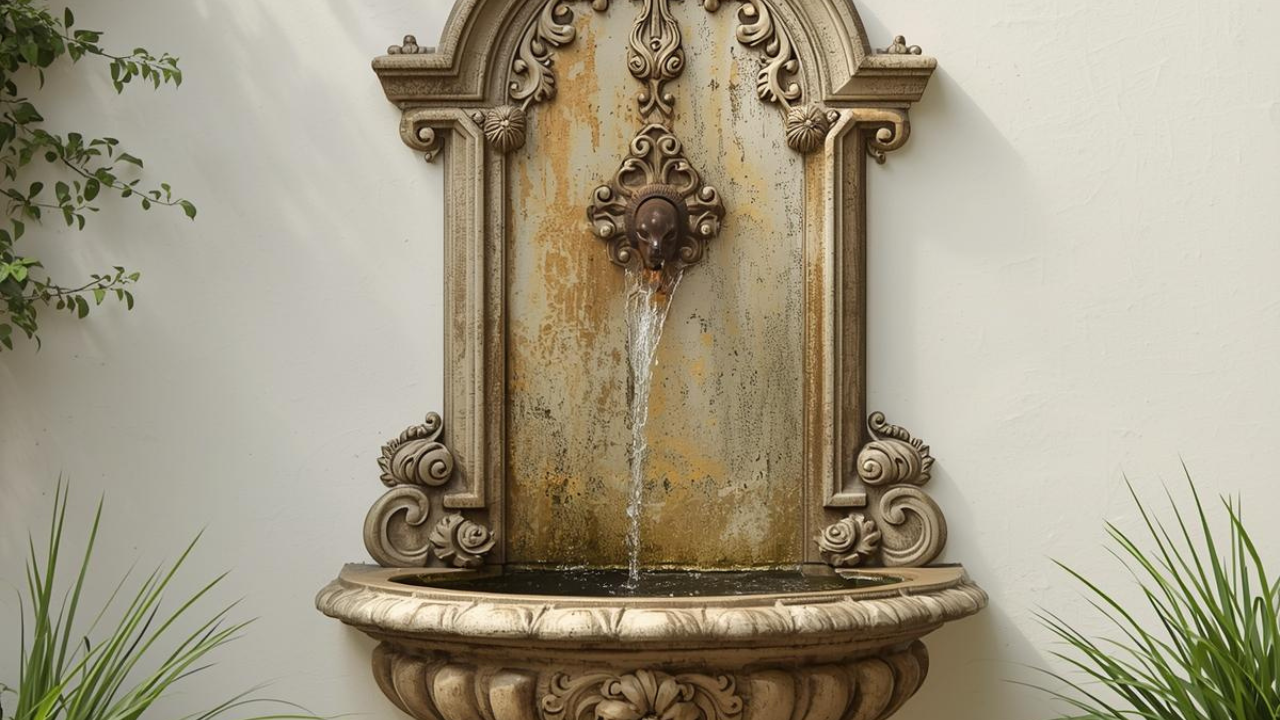
Classic spouts produce bubbling, arched, or directed water streams. Traditional decorative designs can be highly ornamental. Brass, bronze, and copper construction suits classic, Mediterranean, and rustic architectural styles. These create traditional fountain aesthetics with timeless appeal.
Nozzle and jet spouts project water in specific patterns under pressure. Smooth bore creates solid streams, fan jets produce fan shapes, and aerated jets generate bubbly white water. Brass and stainless steel construction handles pressure requirements. These create dynamic, dramatic effects with taller water arcs but require more maintenance due to narrow openings and complex internal structures.
How does water flow determine the right spout choice?
How does flow rate affect sheet thickness and consistency?
Spout width dictates required flow rate measured in Gallons Per Minute (GPM). Wider spouts need more water for solid, unbroken sheets. The general guideline: 10 GPM for every 1 linear foot of spout width achieves 1/4-inch deep sheet. Insufficient flow causes noisy fluttering and uneven coverage.
Laminar flow requires smooth spout surfaces, non-turbulent water supply, and precise flow rates. This produces smooth, clear, glass-like streams where particles flow in parallel paths. The silent operation creates refined tranquil effects. Nozzles designed for laminar flow contain internal baffles or straws straightening the water stream.
Why does projection distance matter for wall fountains?
Mounting height determines sound and splash characteristics. Higher drops create more sound but also more splash. The common rule: 12 to 18 inches fall distance for pleasant sound without excessive overspray. Drop height affects where water lands relative to basin position.
Greater height increases splash risk and water loss. Lower mounting reduces sound output but contains water better. The vertical distance directly impacts both acoustic performance and splash control requirements. Finding the optimal height balances sound goals with practical splash containment.
How does splash behavior influence spout selection?
Overspray causes water loss and damages surrounding surfaces. Basin width must be at least twice the water fall’s drop height for adequate capture. Wider spouts prove more susceptible to wind disruption. Windy locations require deeper basins, lower mounting, or splash guards.
Flow rate too high causes excessive splash. Drop height too great creates overspray. A basin too small fails to capture water. Solutions include reducing pump flow with ball valves, lowering spout mounting, installing splash guards, and increasing basin dimensions. One windy deck installation used a narrow 6-inch brass nozzle instead of wide sheet flow, with 18-inch deep and 48-inch wide basin plus copper mesh splash guard.
How do spout materials affect performance and longevity?
How does stainless steel handle continuous water exposure?
Stainless steel offers a sleek modern aesthetic with excellent durability. 316 marine-grade stainless steel provides superior rust and corrosion resistance. This grade proves ideal for all climates including saltwater environments. Common for scupper, sheet flow, spillway, and nozzle spouts.
Cold climate installations benefit from 316 stainless steel’s durability. One freezing-winter fountain used a heavy-duty 316 stainless spillway with a pondless reservoir buried 30 inches below ground beneath the frost line. All plumbing sloped for complete drainage during winterization prevents pipe cracking from ice expansion.
Why are copper and brass used for wall fountain spouts?
Copper develops a beautiful blue-green patina over time while remaining durable and rust-resistant. The relatively lightweight construction simplifies installation. Copper will not stain porous surfaces like stone—critical for natural stone installations. Timeless elegance suits scupper and classic spout designs.
Brass and bronze offer classic sophisticated looks for traditional or historical designs. Extremely durable and corrosion-resistant, these metals develop rich aged finishes over time. Common for classic spouts and nozzle applications. One small patio fountain used a 12-inch copper scupper mounted 15 inches above the basin, requiring only 10 GPM for pleasant sound without splash issues.
How do stone and concrete spouts affect flow control?
Concrete spillway spouts suit larger water features and naturalistic designs, handling higher volumes. The material complements pool integrations and natural landscape features.
Composite materials (fiberglass, resin) offer lightweight, affordable options mimicking stone or metal. However, these prove less durable and prone to cracking or UV color fading. Choosing durable materials ensures longevity in outdoor conditions.
How does wall fountain size impact spout selection?
How does wall width relate to spout length?
Wider spouts require significantly higher flow rates and more powerful pumps. The 10 GPM per linear foot rule means 12-inch spouts need approximately 10 GPM while 48-inch spillways demand 40 GPM. Wider spouts create powerful visual impact but increase pump requirements and wind susceptibility.
Small patio installations use 12-inch spouts with 10 GPM flow requiring only small, quiet, energy-efficient pumps. Larger installations accommodate spillway widths from 12″ to 48″. The spout width determines pump size, energy consumption, and wind vulnerability. Scale spout selection to available space and infrastructure.
How does basin size affect water capture?
Basin width must be at least twice the drop height to prevent overspray and water loss. This captures all water regardless of minor wind interference. Deeper basins provide additional splash containment. Pump submersion requires at least 4-6 inches water depth minimum to prevent cavitation.
Deeper basins defend against pump damage, frequent refilling, and water quality issues. Shallow basins under 4 inches significantly increase evaporation, pump cavitation, and freeze damage risks. A small patio example used a 10-inch deep, 30-inch wide basin for a 15-inch drop. Windy locations need 18-inch depth and 48-inch width for maximum containment.
Why does mounting height change water behavior?
Spout height above basin water level determines sound and splash. Higher drops create more sound but also more splash. 12-18 inches provides pleasant sound without excessive overspray for most installations. This height balances acoustic goals with splash control.
Greater height amplifies sound output and increases splash risk. Lower mounting reduces both sound and splash. The vertical distance impacts projection patterns and where water lands. Adjusting mounting height fine-tunes the fountain’s performance characteristics to match site conditions.
What pump specifications must match the spout?
How is pump flow capacity matched to a spout?
Pumps must deliver required GPM at specified head height (vertical distance). Always select pumps exceeding minimum requirements to allow flow adjustment. Better to dial down oversized pumps than struggle with undersized units. Understanding fountain pump sizing ensures adequate capacity.
Ball valve installation on the pump outlet proves essential for fine-tuning flow rate. This allows adjustment to perfect visual and acoustic effects while preventing overspray. Sheet flow spouts need 10 GPM per linear foot for 1/4-inch sheet depth. Wider spouts demand proportionally more powerful pumps as charts illustrate.
How does head height affect spout output?
Pumps must deliver required flow at the specified vertical lift distance (head height). Greater head height reduces the pump’s effective flow rate. Pump selection must account for both flow requirements and vertical distance. Higher mounting positions require more powerful pumps maintaining desired flow.
Head height represents the vertical distance pumps push water from reservoir to spout. Each foot of additional lift decreases pump efficiency. Manufacturers provide pump curves showing GPM output at various head heights. Matching pump specifications to actual installation height ensures adequate performance.
Why do mismatched pumps cause uneven water flow?
Undersized pumps cannot achieve solid, unbroken sheets for wide spouts. Flow rate too low causes noisy flow and fluttering. Water may favor one side if flow is insufficient to cover full weir width. Undersized units cannot be adjusted upward to fix problems.
Oversized pumps without control cause overspray and excessive splash. Flow rate too high wastes energy and damages surrounding surfaces through water loss. Ball valve control prevents these issues. Pump cavitation from low water levels creates loud grinding—turn off immediately and add water until the pump is fully submerged by 4-6 inches minimum.
How do indoor and outdoor environments affect spout choice?
Why do indoor wall fountains require tighter flow control?
Indoor applications cannot tolerate overspray due to interior surface damage risks. Precise splash control proves mandatory. Sound levels need careful management for indoor spaces. Laminar flow is often preferred indoors—silent, refined, tranquil effects suit interior environments.
The ball valve proves essential for fine-tuning to achieve perfect flow without splash. Indoor installations require smaller spouts with controlled flow patterns. Sheet flow and scupper designs work well indoors when properly sized. The contained environment demands precision in flow rate and splash management.
How do weather and temperature affect outdoor spouts?
316 marine-grade stainless steel handles all climates including saltwater environments with superior rust and corrosion resistance. Composite materials (fiberglass, resin) suffer cracking or UV color fading in harsh climates. Temperature cycling stresses lower-quality materials.
Cold climates require special planning. Pondless reservoirs buried 30 inches below frost lines prevent freeze damage. All plumbing must slope for complete drainage during winterization preventing pipe cracking from ice. Metal spouts (copper, brass, bronze) develop protective patinas naturally. UV exposure causes color fading in composites over time.
How does wind exposure alter water projection?
Wider spouts prove more susceptible to wind disruption causing overspray and water loss. Exposed locations demand special considerations. Choose narrow nozzle spouts over wide sheet flow to minimize wind interference.
Install splash guards at basin surfaces. Deeper and wider basins contain wind-driven splash. Lower mounting heights reduce wind effects. One windy deck installation chose a 6-inch brass nozzle, used an 18-inch deep, 48-inch wide basin, and added copper mesh splash guard.
How do maintenance requirements vary by spout type?
Which spout designs are more resistant to clogging?
Narrow openings and complex internal structures (like nozzles) clog more easily. Debris or mineral scale buildup (calcium) causes blockages. Nozzles with internal baffles or straws for laminar flow require more maintenance. These designs trap particles more readily.
Wide, simple spillway and scupper designs resist clogging better. Fewer internal structures mean less debris accumulation. Sheet flow and weir spouts with wide openings clean easier. Simple designs reduce maintenance frequency and difficulty compared to complex nozzle configurations.
How do mineral deposits affect different spout materials?
Calcium deposits affect all spout types but impact narrow openings more severely. Using distilled water reduces mineral buildup significantly. Stainless steel shows deposits but doesn’t degrade. Copper’s natural patina can disguise minor deposits.
Brass and bronze aged finishes mask some mineral buildup. Sheet flow spouts suffer most—deposits on weir lips affect flow patterns significantly. Mineral accumulation causes water to favor one side. Regular cleaning prevents permanent scaling. Quality fountain parts and supplies include cleaning solutions for mineral control.
How often should wall fountain spouts be cleaned?
Narrow openings and complex structures require more frequent cleaning. Debris accumulation rate depends on the environment. Mineral buildup happens faster in hard water areas. Clean spout lips meticulously to prevent noisy flow and fluttering.
Use levels to check spout alignment during cleaning. Inspect for debris on weir edges regularly. Distilled water use reduces cleaning frequency by minimizing mineral deposits. Maintenance schedules vary from monthly for complex nozzles to quarterly for simple spillways depending on water quality and environmental conditions.
How does design style influence spout selection?
Which spout profiles suit modern wall fountains?
Scupper spouts offer clean, minimalist looks ideal for modern, contemporary, and formal garden designs. Sheet flow and weir spouts create elegant, reflective water walls with serene effects. Stainless steel provides a sleek modern aesthetic. 316 marine-grade versions ensure superior durability.
Acrylic sheet flow creates glass-like effects for contemporary installations. Modern spillways in stainless steel suit pool and pond integrations. Visual characteristics include smooth, continuous sheets, minimalist designs, and elegant water curtains. Thin, glass-like, often silent sheets complement modern architecture.
Which spouts complement traditional or natural designs?
Classic spouts produce traditional decorative effects—bubbling, arched, or directed streams. Highly ornamental designs suit classic, Mediterranean, and rustic architectural styles. Concrete spillways create naturalistic cascading effects mimicking natural waterfalls. These suit larger features with pool and pond integrations.
Brass, bronze, and copper offer classic sophisticated looks developing rich aged finishes over time. Timeless elegance with blue-green copper patinas enhances traditional aesthetics. Naturalistic designs use substantial cascading effects. Material choices reinforce design themes through appearance and aging characteristics.
How does spout shape affect overall balance?
Spout width must be proportionate to wall size for visual balance. Mounting height affects visual weight and perceived scale. Flow pattern (sheet vs. stream) changes how the feature appears in context. Wide dramatic waterfalls create striking visuals but require large pumps and basins.
Smaller, well-designed features often prove more reliable and enjoyable than oversized dramatic installations. Balance aesthetics with practicality for best results. Consider the spout as one element in the overall composition. Proportional relationships between spout, wall, and basin create harmonious installations.
What mistakes should be avoided when choosing a wall fountain spout?
Why is choosing based on appearance alone risky?
Dramatic wide waterfalls may be visually striking but require large pumps, basins, and high energy consumption. Wind susceptibility increases with spout width. Higher maintenance requirements aren’t immediately apparent from appearance. Smaller, well-designed features often prove more reliable and enjoyable long-term.
Aesthetic-only selection ignores material durability in outdoor conditions, maintenance requirements, pump and energy demands, and basin sizing needs. The most beautiful spout fails if impractical for the installation site. Practical considerations must inform aesthetic choices for functional, reliable operation.
How does incorrect sizing impact performance?
Flow rate too low for spout width causes noisy flow and fluttering. Cannot achieve solid, unbroken sheets. Undersized basins cause overspray. Undersized pumps cannot be adjusted upward to correct problems.
Over-sizing without control causes excessive splash and energy waste. The 10 GPM per linear foot rule frequently gets underestimated. A basin twice as wide as drop height often gets skimped on. 12-18 inch optimal drop height gets exceeded for dramatic effect causing splash problems.
Why is ignoring pump compatibility a common issue?
Pumps must deliver the required GPM at specified head height (vertical lift). Failing to account for vertical distance reduces effective flow. Mismatch between pump capacity and spout requirements causes performance failures. Common mistakes include selecting pumps based on max GPM without considering head height.
Not providing flow adjustment capability (ball valve) limits fine-tuning options. Undersized pumps cannot meet spout flow requirements. Ignoring pump submersion depth requirements (4-6 inches minimum) causes cavitation. Always select pumps exceeding minimum requirements and install ball valves for adjustment capability.
What should you consider before finalizing a wall fountain spout?
How do space, flow, and maintenance priorities align?
The basin must be at least twice as wide as drop height. Mounting height typically 12-18 inches for optimal performance. Wider spouts need proportionally larger basins. Flow requirements follow the 10 GPM per linear foot rule for sheet spouts.
Pumps must exceed minimum flow requirements. The ball valve proves essential for fine-tuning. Narrow openings and complex structures require more maintenance. Sheet flow spouts need perfectly level lips.
When is professional guidance recommended?
Cold climate setups with frost line burial (30 inches below ground) require expertise. Sloped plumbing for complete drainage during winterization prevents damage. Precise flow rate calculations for large spouts benefit from professional input. Wind-exposed locations requiring custom splash solutions need experienced design.
Pool and pond integrations demand professional planning. Proper pump sizing accounting for head height ensures adequate performance. Accurate flow rate calculations prevent costly mistakes. Basin depth and width optimization maximizes reliability. Professional fountain services provide expertise for complex installations.
What is the next step in selecting the right wall fountain spout?
Determine design style first—modern, traditional, or naturalistic. Measure available space for basin and mounting. Calculate required flow rate based on spout width (10 GPM/ft). Select appropriate materials for your climate conditions. Choose pumps exceeding minimum requirements.
Plan for flow control with ball valve installation. Consider wind exposure and splash mitigation needs. Evaluate your maintenance tolerance level. Review case examples for similar situations. Consult troubleshooting guides for common issues. Plan winterization if it is a cold climate. Budget for quality materials ensuring longevity.
Select Your Perfect Spout With Expert Support
Wall fountain spout selection determines visual character, sound output, and maintenance requirements. The 10 GPM per foot rule, 12-18 inch mounting height, and basin-twice-drop-width guideline provide solid foundations. However, wrong material choices, improper sizing, and pump mismatches create persistent problems compromising fountain performance.
Orange County Pond Services specializes in wall fountain design matching spouts to site conditions and owner preferences. Our team handles flow calculations, pump sizing, material selection, and installation ensuring reliable operation. We prevent common mistakes through proper planning and professional execution. Contact us for expert consultation and discover which spout configuration delivers the performance, aesthetics, and low-maintenance operation your property deserves.