Key Takeaways:
- Waterfalls generate 45-75 dB creating natural white noise that masks background sounds, while water walls operate at 38-52 dB—ideal for quiet indoor applications.
- Monthly maintenance ranges from 2.5 hours for indoor water walls to 9.0 hours for waterfalls with ponds, with professional services costing $75-150/hour.
- Water walls use 20-40% less energy through straightforward vertical plumbing, while waterfalls require complex systems with higher friction loss.
- Installation costs range from $2,000-6,000 for small water walls and $1,500-4,000 for small waterfalls, scaling to $40,000+ for large custom features.
- Water walls reduce water loss by 50-70% through minimal splash and evaporation compared to waterfalls with high splash and aeration.
Waterfalls and water walls both circulate water for aesthetic appeal but achieve completely different effects. A waterfall cascades over rocks, creating natural drama and ambient sound. A water wall flows down a smooth vertical surface, delivering modern elegance and controlled acoustics.
This guide compares both features across critical factors: water movement, sound profiles, maintenance demands, installation complexity, and operating costs. You’ll learn specific pump requirements, monthly maintenance hours, decibel levels, and cost ranges for different sizes.
What is a waterfall?
A waterfall moves water over edges and rock ledges in a cascading pattern. The pump draws water from a reservoir—either an open pond or hidden underground basin—and pushes it to the top. Water then flows over multiple surfaces, creating dynamic movement and natural sound.
Construction uses natural stones for organic appearance, though pre-cast concrete offers cost-effective alternatives. The basin collects water for recirculation—ponds expose water surface while pondless systems hide reservoirs underground. Pump sizing follows a critical rule: 100 GPH per inch of weir width for gentle trickling, 200+ GPH for robust sheeting.
What is a water wall?
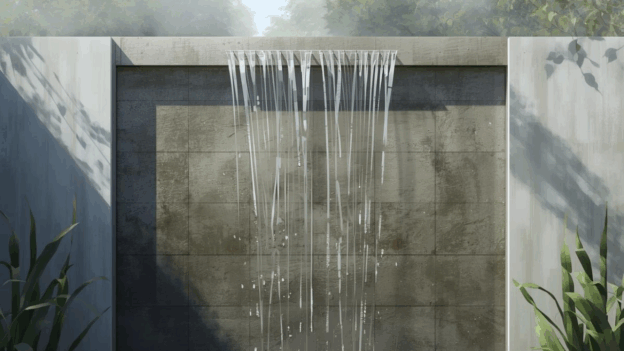
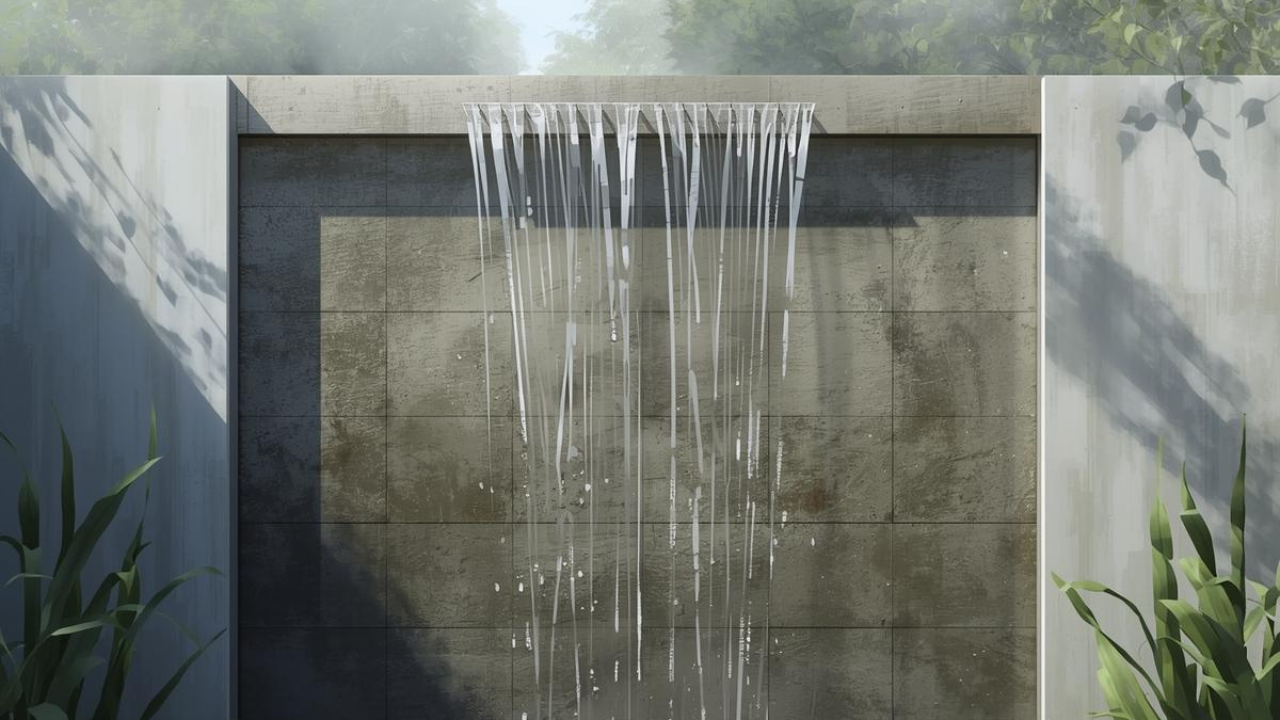
A water wall distributes water evenly down a vertical panel through a top manifold. Water flows in a continuous sheet, creating a mirror-like effect. The system has three main components: vertical panel, base reservoir, and recirculation pump.
Material choices significantly impact appearance. Glass creates transparent shimmer, while slate provides textured organic looks. Acrylic, tile, and stainless steel offer additional design possibilities for architectural fountain applications. The pump pulls water from the base, pushes it to the top manifold, and water sheets down before collecting again.
What are the key differences between a waterfall and a water wall?
How does water flow differ between waterfalls and water walls?
Waterfalls cascade over multiple surfaces with varied heights and angles, creating turbulent flow patterns and dynamic movement. The path includes intentional twists mimicking natural streams. Flow rate adjustments control sound intensity and visual drama.
Water walls produce continuous sheet flow down a single vertical surface. The manifold distributes water evenly, creating smooth descent without turbulence. This controlled flow generates a mirror-like effect with consistent coverage from top to bottom.
How does surface interaction change the visual effect?
Waterfalls present naturalistic, dramatic aesthetics through multi-surface interaction. Water hits multiple rock faces, creating splash patterns and varied flow speeds. This irregular interaction produces organic beauty that blends with garden water fountain designs and naturalistic landscaping. The feature can accommodate both formal tiered structures and informal rock arrangements depending on design goals.
Water walls deliver modern, sleek elegance through single-surface interaction. The smooth vertical flow creates architectural statements suitable for contemporary spaces. Glass panels produce transparent effects while stone surfaces add texture. The consistent sheet creates visual calm rather than dynamic movement, fitting minimalist and professional design aesthetics.
How does gravity influence each water feature differently?
Both features fight gravity through pump power, but waterfalls overcome variable heights across multiple tiers. Multi-tiered designs demand pumps capable of pushing water to the highest point while maintaining adequate flow at each level.
Water walls overcome single vertical heights with constant pressure. The manifold sits at the top of one continuous panel, simplifying calculations. Pump sizing focuses on delivering adequate volume for complete panel coverage rather than reaching multiple elevation points.
How do waterfalls and water walls differ in sound and appearance?
Why do waterfalls create more ambient sound?
Waterfalls generate 45-75 decibels depending on size. Small waterfalls produce 45-55 dB with soft cascading sounds. Medium features reach 52-65 dB with pronounced cascading that masks background noise. Large installations hit 60-75 dB, creating dramatic rushing water.
The cascading action creates natural white noise through water droplets, splash patterns, and turbulent flow. Sound customization happens through flow rate adjustment and height variation. This ambient noise masks traffic, pool equipment, and neighboring properties.
Why do water walls produce a more controlled sound profile?
Water walls operate at 38-52 decibels—significantly quieter than waterfalls. Smooth panels generate 38-45 dB. Textured surfaces reach 42-52 dB with gentle rippling. This whisper-quiet operation makes water walls ideal for indoor applications.
Sound minimization comes from continuous sheet flow without splash or turbulence. Smooth materials like glass produce quieter operation than rough textures. Indoor installations may amplify sound by 3-5 dB due to reflections, but water walls remain appropriate for commercial lobbies and residential interiors.
Which feature creates more splash and mist?
Waterfalls produce moderate to high splash depending on height and design. Water falls through air, creating droplets and mist before hitting surfaces or basins. Higher falls generate more splash and overspray. The cascading action aerates water, producing visible mist in certain lighting conditions. This splash requires consideration for nearby furniture, flooring, and structural elements in outdoor and indoor applications.
Water walls generate low to minimal splash because water maintains surface contact throughout descent. The vertical sheet doesn’t fall through open air, eliminating most droplet formation. This contained flow prevents water damage to surrounding areas—critical for indoor installations and spaces with sensitive furnishings. The low splash profile allows water walls near seating areas, artwork, and electronics without protection concerns.
How do maintenance requirements differ between waterfalls and water walls?
Why do waterfalls collect organic debris more easily?
Waterfalls demand high maintenance—5.5 to 9.0 hours monthly. Pondless waterfalls require 5.5 hours: 2.0 hours routine cleaning, 1.0 hour filter/pump maintenance, 1.0 hour water quality management, 1.5 hours seasonal tasks. Features with open ponds jump to 9.0 hours: 3.5 hours cleaning, 1.5 hours filter/pump work, 2.0 hours water quality control, 2.0 hours seasonal maintenance.
Open basins and horizontal rock surfaces trap falling leaves and organic debris. Multiple ledges create collection points requiring manual cleaning. Pond configurations expose large water surfaces to contamination from surrounding vegetation.
How do water walls experience mineral and scale buildup?
Water walls need moderate maintenance—2.5 to 5.5 hours monthly. Indoor installations require only 2.5 hours: 1.0 hour cleaning, 0.5 hours filter/pump maintenance, 0.5 hours water quality management, 0.5 hours seasonal work. Outdoor water walls demand 5.5 hours due to environmental exposure.
Vertical surfaces show mineral deposits more visibly than horizontal rock surfaces. Regular surface cleaning prevents permanent mineral etching. However, vertical orientation prevents debris accumulation that plagues horizontal waterfall surfaces.
Which option requires more frequent cleaning?
Waterfalls with ponds top the maintenance scale at 9.0 hours monthly—the highest commitment. Pondless waterfalls and outdoor water walls tie at 5.5 hours monthly. Indoor water walls deliver the lowest burden at 2.5 hours monthly. Professional maintenance services charge $75-150 hourly, translating to $187.50-375 monthly for indoor water walls versus $675-1,350 monthly for pond waterfalls.
Automated systems including auto-fill and UV filters reduce maintenance by 20-30% across all feature types. However, base requirements remain significantly different. Features with open water surfaces and organic debris exposure require more intervention regardless of automation. Indoor controlled environments minimize contamination and evaporation, cutting maintenance demands substantially compared to outdoor installations exposed to weather and vegetation.
How do pump and filtration needs differ between the two?
How does pump sizing differ for waterfalls versus water walls?
Waterfalls require complex pump sizing, especially for large features. The standard guideline calculates 100 GPH per inch of weir width for gentle effects, scaling to 200+ GPH per inch for robust sheeting. The pump must overcome total head height—the vertical distance from reservoir surface to highest spillway point. Multi-tiered designs add complexity as each level requires adequate flow while the pump fights cumulative elevation.
Water walls need simpler pump sizing with straightforward recirculation. The pump overcomes single vertical panel height without multiple elevation changes. Flow rate determines sheet thickness and complete panel coverage. The manifold distributes water evenly, reducing pump pressure requirements compared to forcing water through complex waterfall plumbing. This simplified hydraulic design allows smaller pumps for equivalent visual impact.
Why does filtration demand vary by feature type?
Waterfalls with ponds face highest filtration demands at 2.0 hours monthly for water quality management. Open basins collect organic material that decomposes, releasing nutrients and consuming oxygen. This biological load requires intensive filtration to maintain water clarity and prevent algae blooms. Pondless waterfalls reduce filtration needs to 1.0 hour monthly by eliminating exposed water surfaces.
Indoor water walls require minimal filtration at 0.5 hours monthly due to enclosed systems and zero outdoor contamination. No falling leaves, pollen, or organic debris enters the system. Vertical surfaces collect less sediment than horizontal pond bottoms. This reduced biological load allows simpler filtration with less frequent media changes and chemical treatment.
How does circulation design affect long-term reliability?
Waterfall plumbing involves multiple connection points from reservoir to pump to various spillway levels. Each connection represents a potential leak point requiring periodic inspection. Complex routing increases friction loss, forcing pumps to work harder and consume more electricity. Seasonal maintenance averages 1.5-2.0 hours monthly for winterization and spring startup in freezing climates.
Water wall circulation uses straightforward vertical runs from base reservoir to top manifold. Fewer connections reduce failure points and simplify troubleshooting. The direct path minimizes friction loss and pump strain. Indoor installations require only 0.5 hours monthly seasonal maintenance due to climate control. This mechanical simplicity translates to higher long-term reliability and lower repair frequency over the feature’s operational lifetime.
Which option is better suited for indoor or outdoor use?
Why are water walls commonly used indoors?
Water walls operate at 38-45 dB for smooth versions—quieter than normal conversation at 60 dB. This whisper-quiet operation won’t disrupt indoor spaces designed for work or relaxation. Low splash risk prevents water damage to surrounding furnishings, electronics, and architectural elements. The vertical space-efficient design fits commercial lobbies and modern residential interiors without consuming valuable floor area.
Indoor water walls demand only 2.5 hours monthly maintenance—the lowest commitment across all water feature types. No exposure to falling debris, temperature fluctuations, or seasonal weather eliminates major maintenance triggers. The controlled environment reduces evaporation and contamination. Professional installation creates sleek focal points for corporate environments, upscale residences, and hospitality settings where sophisticated aesthetics and minimal disruption matter most.
Why are waterfalls more common in outdoor landscapes?
Waterfalls generate 50-67.5 dB average sound levels appropriate for outdoor settings. This ambient noise masks traffic, pool equipment, and neighborhood sounds effectively. The naturalistic aesthetic integrates with existing landscaping, mimicking mountain streams and natural water sources. Large outdoor spaces accommodate the horizontal footprint required for cascading features and collection basins.
Pool integration creates resort-like atmospheres with dramatic water movement. Entry features deliver grand, welcoming statements for residential and commercial properties. The higher splash and overspray acceptable outdoors would damage indoor spaces but enhances outdoor ambiance. Natural lighting and surrounding vegetation amplify visual impact impossible to achieve in controlled indoor environments. These outdoor fountain materials withstand weather exposure that would compromise indoor-focused designs.
How do environmental conditions affect performance?
Waterfalls experience high evaporation from increased surface area and aeration. Cascading action creates droplets and spray that accelerate water loss. Open pond configurations expose maximum water surface to sun and wind, requiring frequent refilling.
Water walls show moderate evaporation—less than waterfalls. Vertical sheet flow minimizes air exposure. However, outdoor water walls face higher maintenance (5.5 hours) than indoor versions (2.5 hours) due to environmental exposure.
What installation factors influence the choice between a waterfall and a water wall?
How does available space affect design selection?
Waterfalls require horizontal space for cascading features and collection basins. Even pondless designs need an excavation area for underground reservoirs and rock arrangements extending outward from the water source. Large outdoor spaces accommodate dramatic multi-tiered features, while cramped areas force compromises in visual impact. Vertical height without horizontal depth limits waterfall design possibilities significantly.
Water walls excel in space-constrained environments through vertical orientation. Wall-mounted installations consume zero floor space—the entire feature exists in otherwise unused vertical areas. Small patios and balconies accommodate water walls that would never fit horizontal waterfall footprints. This space efficiency makes water walls ideal for urban environments, small courtyards, and any location where horizontal real estate carries premium value.
How do structural requirements differ?
Waterfalls demand excavation for basins and foundations supporting rock weight. Underground reservoirs for pondless systems require digging beneath the feature’s footprint. Multiple rock ledges need stable placement preventing shifts or collapses. The combined weight of rocks, water volume, and pump vault requires solid ground or reinforced foundations. Site preparation often involves heavy equipment for earth moving and boulder placement.
Water walls require vertical panel support and base reservoir space. Wall-mounting needs structural verification that existing walls or frames can handle panel weight plus water. Lightweight materials like acrylic suit balconies and rooftop installations where load limits apply. Minimal excavation compared to waterfalls—typically just a shallow base reservoir. This simpler structural demand reduces site preparation costs and installation timeline.
Why does installation complexity vary?
Waterfalls involve complex installation, especially for medium and large features. Professional installation ranges from $1,500-4,000 for small features (typical $2,750) to $10,000-30,000 for large installations (typical $20,000). Medium waterfalls cost $4,000-10,000 (typical $7,000). Complexity comes from rock placement, multi-level plumbing, reservoir construction, and achieving natural aesthetics. DIY installation cuts costs 30-50% for small features but requires significant skill.
Water walls feature straightforward installation with simpler recirculation. Small water walls cost $2,000-6,000 (typical $4,000), medium installations run $5,000-15,000 (typical $10,000), and large features reach $12,000-40,000 (typical $26,000). Higher base costs reflect premium materials like glass and stainless steel plus precision manufacturing. However, simpler plumbing and fewer components reduce labor hours. Installation costs exclude electrical work, permits, and ongoing maintenance across both feature types.
How do waterfalls and water walls compare in water usage and efficiency?
How does evaporation differ between open and vertical designs?
Waterfalls lose significant water through evaporation due to increased surface area exposure. Cascading action creates droplets and spray, maximizing air contact. Each tier adds evaporation surface area. Pond configurations expose large water surfaces to sun and wind. Aeration during cascade accelerates evaporation rates beyond still water calculations. Hot, dry climates compound these losses, requiring daily refilling during peak seasons.
Water walls experience moderate evaporation—generally less than waterfalls of similar scale. Vertical sheet flow maintains minimal air exposure compared to cascading droplets. The enclosed base reservoir limits exposed surface area to a small collection basin. Contained flow without aeration reduces evaporation drivers. Indoor installations show 40-60% less evaporation than outdoor features due to climate control and absence of direct sunlight.
Which feature typically experiences higher water loss?
Waterfalls suffer combined losses from evaporation and splash overspray. Wind-blown spray and mist escape the system. Moderate to high splash sends water beyond collection zones. Large features in windy locations can lose 5-10% of system volume daily.
Water walls retain water through low splash design. Sheet flow rarely produces airborne droplets. Only evaporation from the base reservoir contributes to loss. This controlled operation reduces makeup water requirements by 50-70% compared to waterfalls.
How does recirculation efficiency compare?
Waterfalls employ complex plumbing with multiple connection points and longer pipe runs. Each connection adds friction loss, forcing pumps to work harder. Energy costs accumulate over continuous operation.
Water walls use straightforward vertical plumbing from base to manifold. Minimal connections reduce friction loss. Direct routing preserves pump pressure for water movement rather than fighting system resistance. This hydraulic efficiency translates to 20-40% lower operating costs.
Which option fits different design goals and use cases?
Which feature works better for natural landscapes?
Waterfalls deliver naturalistic aesthetics that integrate with outdoor landscaping. The design mimics mountain streams using varied rock sizes and organic placement. Integration with existing plantings creates cohesive landscape designs where the water feature appears natural rather than artificial.
The cascading effect attracts birds and wildlife. Gentle babbling sounds complement outdoor settings designed for contemplation. Rock gardens and native plantings complete the natural retreat appearance.
Which feature fits modern or architectural spaces?
Water walls provide modern, sleek elegance matching contemporary architecture. Glass panels create sophisticated transparency. Stainless steel delivers industrial chic. Clean lines and geometric precision suit minimalist design.
Zero footprint vertical installations complement space-efficient urban design. The architectural statement works in corporate lobbies, upscale residences, and hospitality settings. Whisper-quiet operation maintains a calm atmosphere essential in modern professional environments.
How does long-term upkeep influence the decision?
Indoor water walls require 2.5 monthly hours—best for busy lifestyles. This costs $187.50-375 monthly with professional service. Outdoor water walls and pondless waterfalls demand 5.5 hours at $412.50-825. Waterfalls with ponds top requirements at 9.0 hours monthly, translating to $675-1,350 in maintenance expenses.
Over five years, indoor water walls cost $11,250-22,500 in maintenance versus $40,500-81,000 for pond waterfalls. Features requiring 9.0 monthly hours accumulate 540 hours over five years. Professional fountain maintenance services handle routine care but costs compound over ownership periods.
What should you consider before choosing between a waterfall and a water wall?
How do design goals, maintenance needs, and space come together?
Define your primary goal before evaluating features. Dramatic focal points requiring noise masking suit waterfalls generating 50-75 dB. Subtle background elements demanding quiet operation need water walls at 38-52 dB. Modern architectural statements benefit from water wall precision while natural wildlife habitats require waterfall aesthetics.
Assess available space against feature requirements. Waterfalls need horizontal area for cascades and basins—measure carefully and consider scale relative to surroundings. Water walls fit vertical spaces with minimal horizontal footprint. Budget realistically: small features cost $500-6,000, medium installations $4,000-15,000, large projects $10,000-40,000+. Factor installation, electricity, and maintenance into total ownership calculations. Honestly evaluate maintenance tolerance—2.5 to 9.0 monthly hours represents significant commitment over years of ownership.
When is professional guidance recommended?
Professional design helps optimize medium and large installations. Landscape architects ensure proper integration with surrounding elements and adequate structural support. Water feature specialists handle complex pump sizing, plumbing design, and material selection. Technical expertise prevents costly mistakes in circulation design, electrical requirements, and long-term reliability factors.
Professional installation proves essential for features exceeding $5,000 investment. Improper installation creates persistent problems: inadequate pump capacity, plumbing leaks, structural failures, and poor aesthetic results. Warranties protect installation quality and component performance. Specialists verify load-bearing capacity for wall-mounted features and proper reservoir sizing for evaporation and splash losses. This expertise delivers features that perform reliably rather than requiring constant troubleshooting.
What is the next step in selecting the right water feature?
Match your property type to appropriate features using specific criteria. Residential courtyards suit water walls or rock garden fountains—both space-efficient with controlled sound. Commercial lobbies demand water wall sophistication and low maintenance. Pool areas integrate waterfalls for dramatic resort aesthetics and traffic noise masking. Entry features choose between waterfall grandeur and water wall modern elegance based on architectural style.
Prioritize your decision factors clearly. Natural landscapes favor waterfalls. Modern spaces demand water walls. High sound requirements select waterfalls. Quiet ambiance needs water walls. Limited horizontal space dictates water walls. Low maintenance tolerance eliminates pond waterfalls. Indoor applications default to water walls. Budget constraints under $5,000 limit options to small features or rock garden fountains.
Choose Your Water Feature With Expert Support
Selecting between waterfalls and water walls requires balancing aesthetics, maintenance capacity, and budget realities. The wrong choice creates ongoing frustration through excessive upkeep demands, inadequate sound profiles, or poor space integration. Data-driven comparison prevents expensive mistakes that compromise your investment.
Orange County Pond Services specializes in matching water features to property requirements and owner capabilities. Our team evaluates your space, assesses structural requirements, sizes pumps correctly, and designs circulation systems for long-term reliability. We handle installation for both waterfalls and water walls, ensuring proper integration with your landscape or architecture. Contact us for professional consultation and discover which water feature delivers the performance, aesthetics, and maintenance profile your property actually needs.
